

Features
The full feature catalog with pointers to the modules that implement each one.
On this page
A complete tour of what PowerDNS-AuthAdmin does, grouped by concern, with module pointers so you can jump straight into the code that owns each feature.
Reading this document. Each section starts with what the feature does, then where the code lives, then how to use / configure it. If you want a quickstart, read the README first.
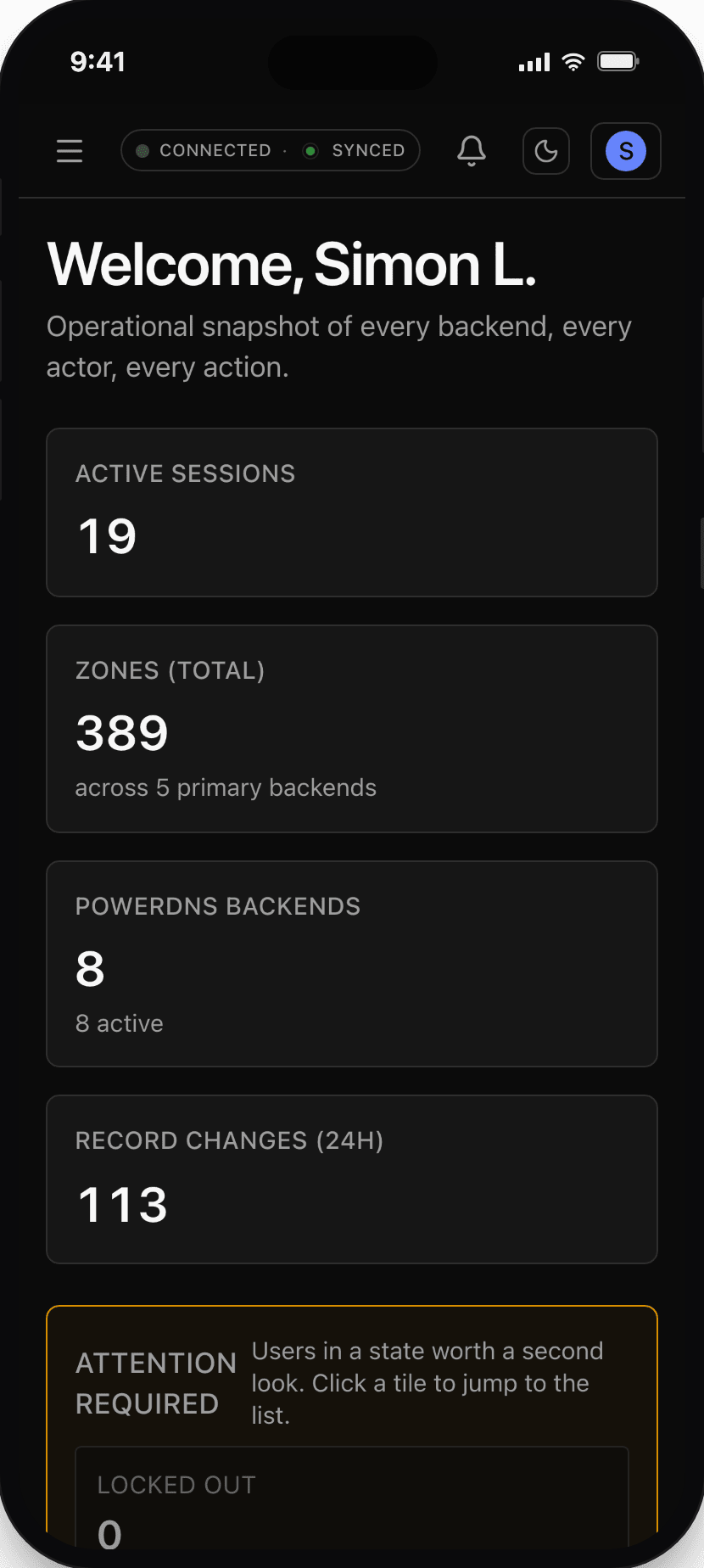
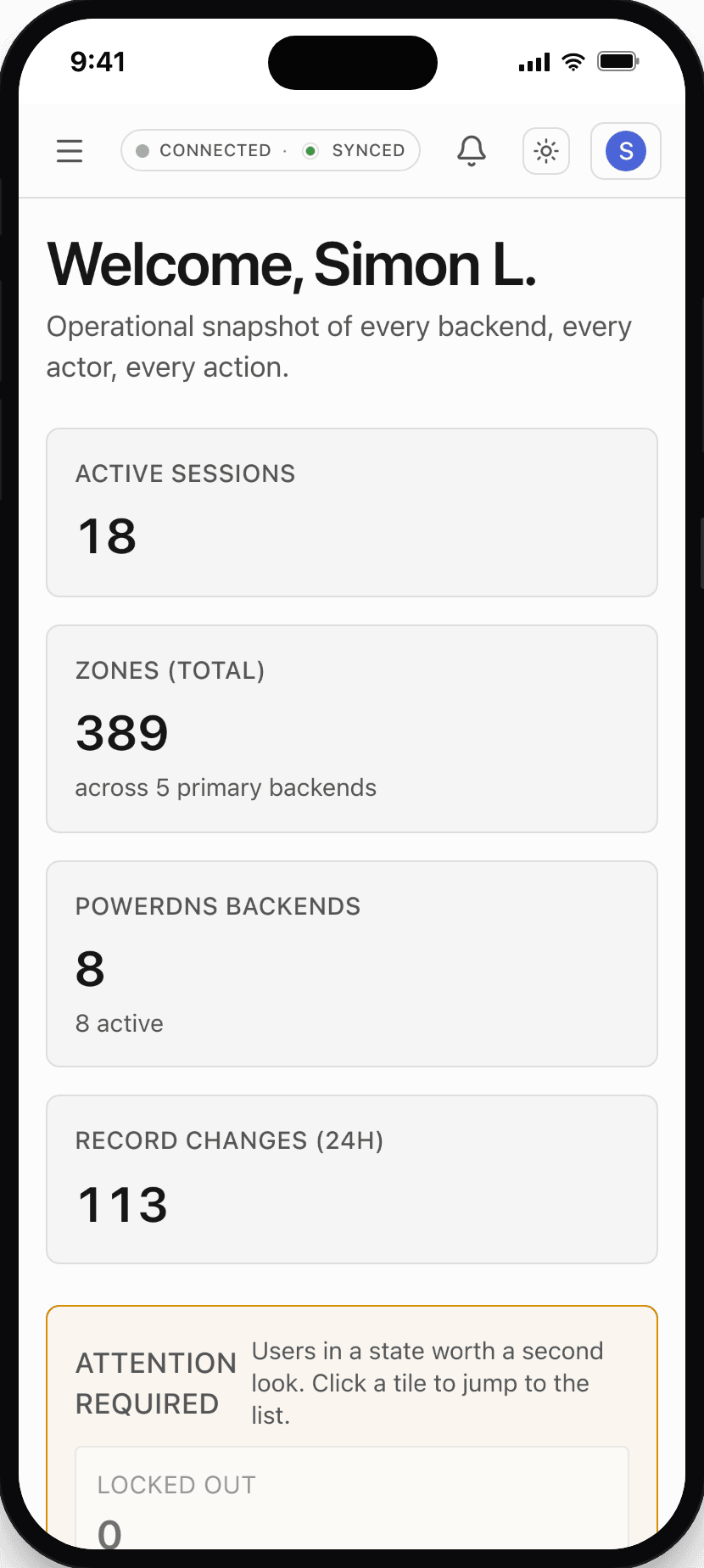
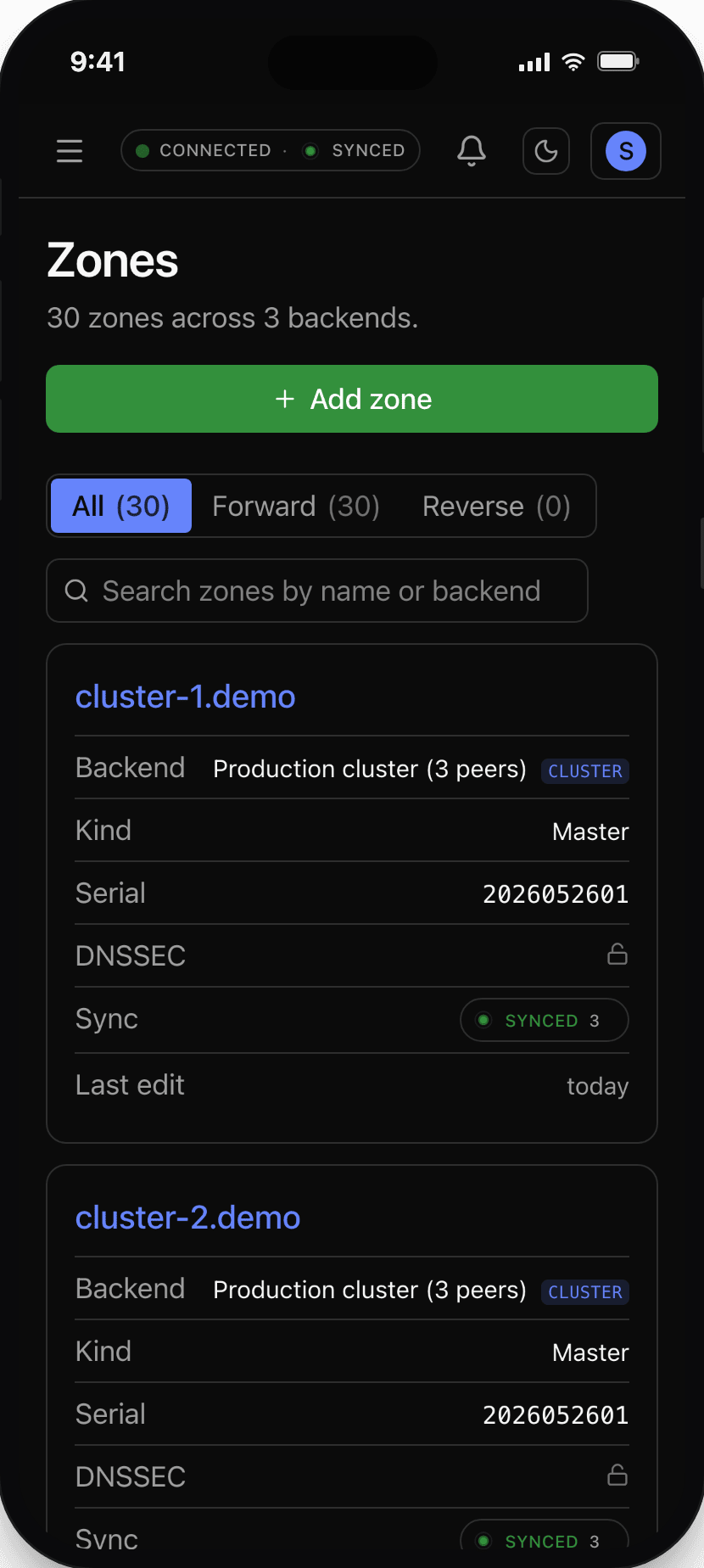
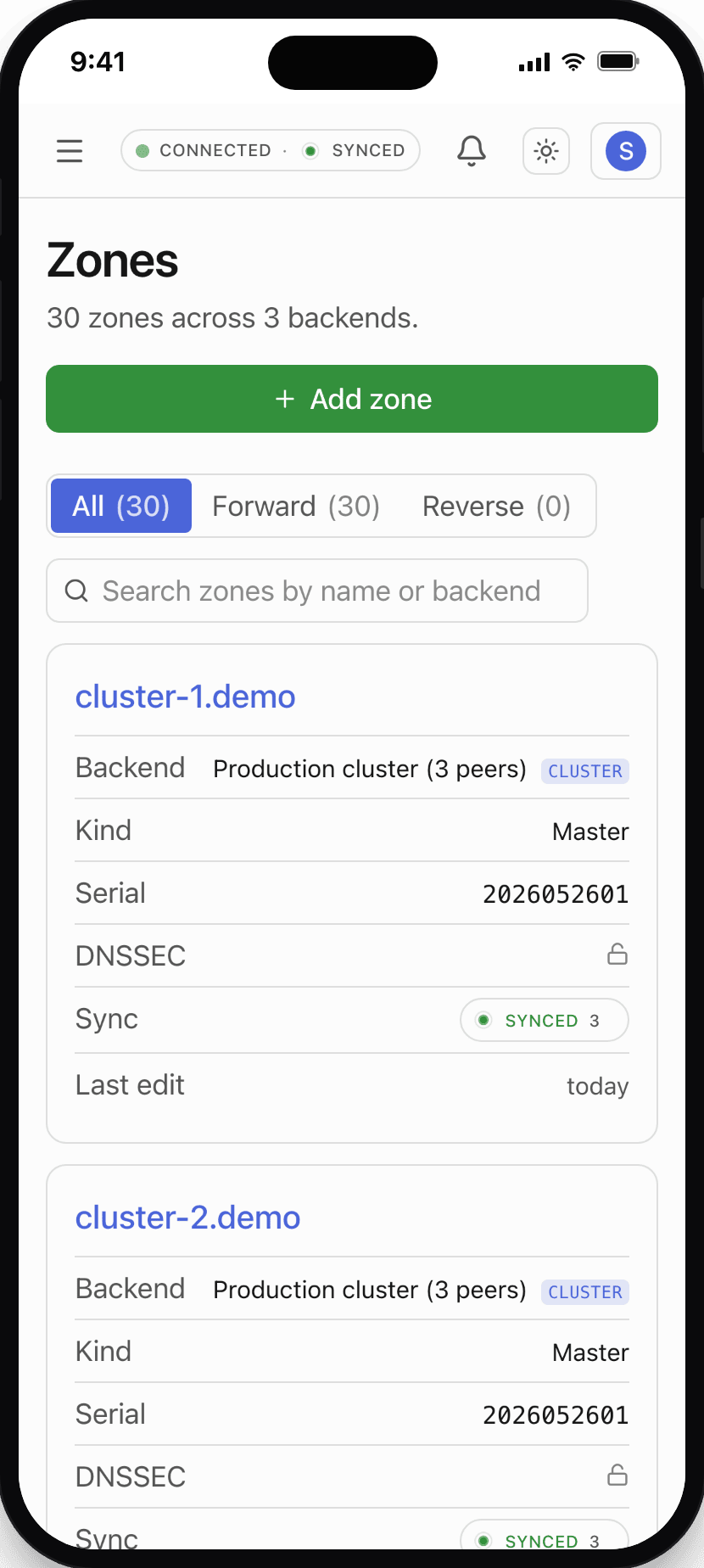
Visual tour. Every page below is captured in light + dark, desktop + iPhone-framed mobile,
in screenshots/. Inline shots in this doc auto-switch theme to
match your reader; click through for the mobile variant.
1. Authentication#
Operator guides: OIDC, SAML 2.0, LDAP,
Passkeys & security keys. Every sign-in method ends in the same
VerifiedIdentity → startSession() path (ADR-0018), so sessions, CSRF, MFA policy and
the audit trail behave identically whichever door the user came through.
1.1 Local accounts (email + password)#
- What. Sign in with email + Argon2id-hashed password. OWASP 2024 parameters. Hashes are
re-derived (
needsRehash) on every successful login if the parameter set has been tightened. - Where.
lib/auth/password.ts,lib/auth/providers/local.ts,app/api/auth/login/route.ts,app/(auth)/login/. - How.
- Bootstrap the first admin via
BOOTSTRAP_ADMIN_EMAIL+BOOTSTRAP_ADMIN_PASSWORDenv (see.env.example). The seed is idempotent - keyed on the email, it ensures that account exists and never clobbers an existing one. - Add more users from
/admin/users(gated onuser.create). The admin can issue a one-time temporary password that forces the user to change on first login. - Lockout policy is operator-tunable:
login_lockout_threshold(1–100 attempts) andlogin_lockout_seconds(60–86400) on the admin Settings page. - The login path is constant-time even when the user doesn't exist - defends against email enumeration.
- Bootstrap the first admin via
1.2 OIDC SSO#
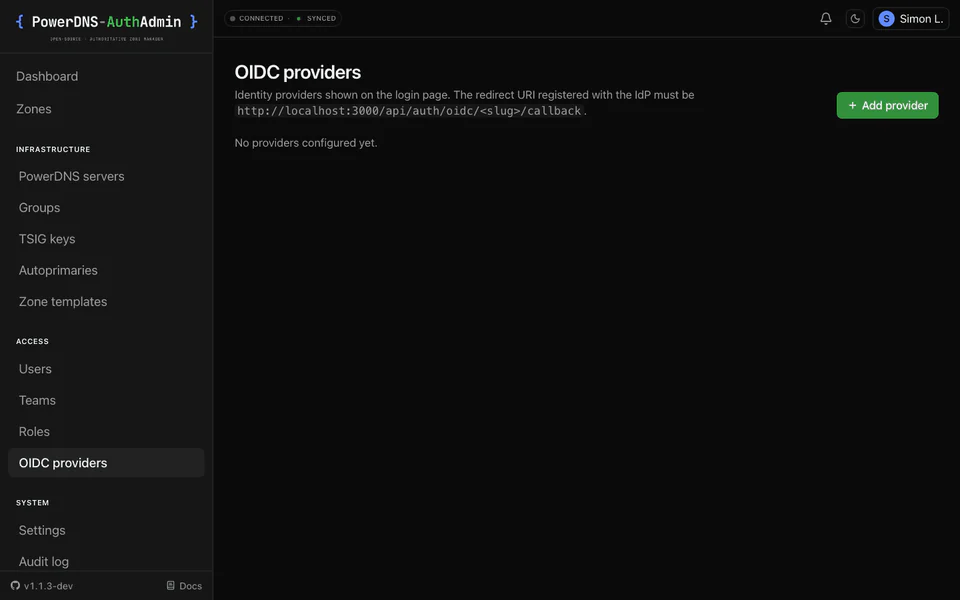
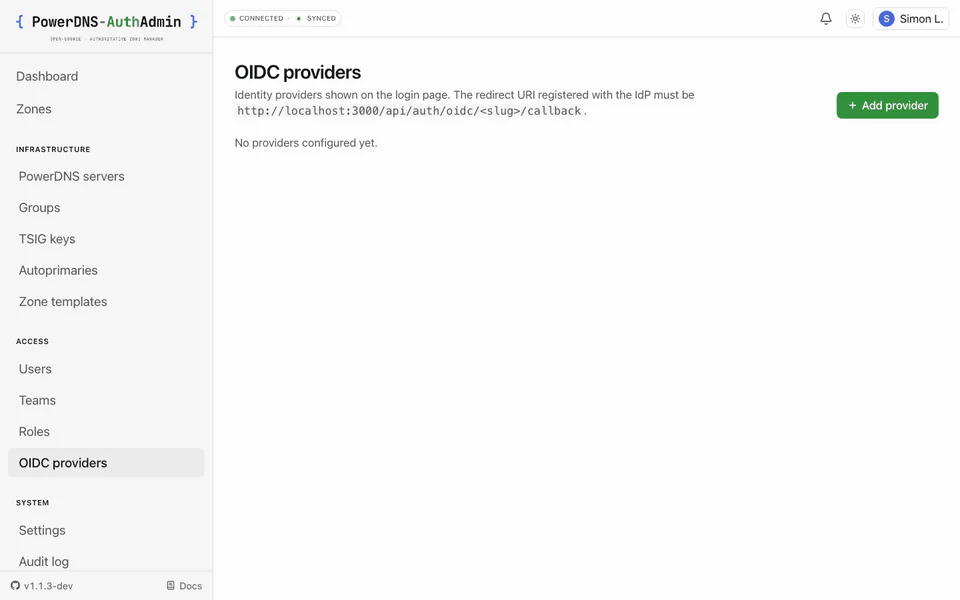
- What. Generic OIDC (Authorization Code + PKCE) via
openid-client. Multiple providers configurable per install. Discovery happens at sign-in; the AS metadata is cached in-process. Auto-detects whether the IdP wantsclient_secret_basicorclient_secret_post; falls back to the other method oninvalid_clientso an IdP whose advertised list disagrees with its per-client config still works. - Where.
lib/auth/providers/oidc.ts,lib/auth/providers/oidc-probe.ts,app/api/auth/oidc/[provider]/{initiate,callback}/route.ts,app/(app)/admin/authentication/(+oidc/[id]/page.tsx). - How.
- Add a provider from
/admin/authentication(gated onauth.manage). The unified Authentication page lists Local Auth + every configured OIDC, SAML and LDAP provider in one table; per-provider edit pages live under/admin/authentication/oidc/<id>(and/saml/<id>,/ldap/<id>). - The redirect URI to register with the IdP is
${APP_URL}/api/auth/oidc/<slug>/callback. - Slugs are globally unique across every authentication provider (OIDC,
SAML, LDAP) - the
auth_provider_slugstable enforces this at the DB level, so the same slug can't be reused across protocol types. - Per-provider toggles:
enabled- hides the provider from the login page when off.require_email_verified- default on; sign-in is blocked unless the IdP attestsemail_verified: true. Defends against account-takeover when the same email exists locally and the IdP lets users set arbitrary unverified emails. Relax it only for IdPs that never emit the claim.allowed_email_domains- per-provider override of the env-level allow-list.
- Default sign-in method lives on the unified Authentication page, not
on individual providers. Pick "Local Auth" or one of the configured
providers from the dropdown;
/loginauto-redirects on a fresh visit (escape hatch:/login?force-local=1). - Discovery health is operator-pollable via the Test button on the providers list AND
the edit page; the result is cached on the row's
discovery_cachefield. - RP-initiated logout. When the IdP advertises an
end_session_endpoint, sign-in captures it + the raw id_token on the session row. Logout navigates the browser to<end_session_endpoint>?id_token_hint=…&client_id=…so the IdP ends its own session and renders its signed-out screen. Nopost_logout_redirect_uriis sent - most IdPs require it pre-registered and silently strip it otherwise.
- Add a provider from
1.3 Group → role mapping (OIDC / SAML / LDAP)#
- What. Derive permissions from a user's IdP group claim on every sign-in. The same
applyGroupSyncruns for OIDC, SAML and LDAP providers. Since 1.4.0 the result is a session-scoped snapshot (sessions.derived_permissions) rather than persistentrole_assignmentsrows, so a user who leaves a group loses the permissions with their next sign-in and admin-issued assignments are never touched. - Where.
lib/auth/providers/group-sync.ts(+group-sync-pure.ts),app/(app)/admin/authentication/oidc/_components/oidc-provider-form.tsx(the editor; the SAML and LDAP forms share the same mapping rows). - How. From a provider's edit page, add rows under Group → role mappings: each row pairs
an IdP group name with a role + scope. Scope syntax is
global,team:<slug>,zone:<fqdn>, orserver:<slug>. Mappings whose role/team/server can't be resolved at sign-in are logged + audited (auth.group_sync.mapping_unresolved, with the provider slug inafter.provider) and skipped - the sign-in still succeeds.
1.4 TOTP (multi-factor)#
- What. Self-service TOTP enrollment for local-password users. Inline SVG QR code rendered
server-side via
qrcode; manual setup-key fallback shown alongside. Standard RFC 6238 with SHA-1, 30s step, ±1 step skew tolerance, hand-rolled HOTP/Base32 inlib/auth/totp.tsto avoid an extra dependency. - Where.
lib/auth/totp.ts,lib/auth/totp-qr.ts,app/(app)/profile/_components/totp-section.tsx,app/api/profile/mfa/totp/route.ts,app/api/auth/login/route.ts(challenge step). - How. From
/profile#mfa, click Enable TOTP, scan the QR with any authenticator app, confirm the 6-digit code. Per-rolerequires_mfaenforcement (set on the role edit page) redirects non-enrolled users to/profile?mfa-required=1until they finish enrolment; either TOTP or a passkey / security key (§ 1.8) satisfies it (lib/auth/mfa-compliance.ts). SSO-only users (no local password) see a read-only "Managed by your identity provider" panel and are exempt from therequires_mfagate - the IdP is their second-factor authority.
1.5 API tokens#
- What. Per-user
pda_pat_…tokens with operator-selected permission scopes from the user's effective set. Argon2id-hashed at rest, public prefix indexable for lookups. - Where.
lib/auth/tokens.ts,lib/db/repositories/api-tokens.ts,app/(app)/profile/_components/api-tokens-section.tsx,app/(app)/admin/users/_components/tokens-panel.tsx,app/api/profile/tokens/. - How. From
/profile#api-tokens, Create token, pick scopes + optional expiry. The plaintext value is shown ONCE and never round-tripped again. Use the token by sending it asAuthorization: Bearer pda_pat_…orX-API-Key: pda_pat_…. Admins withtoken.read.allsee every user's token inventory on the API tokens tab of/admin/users/<id>. For SSO users the token's permissions follow the IdP live - see § 1.13.
1.6 Sessions#
- What. DB-backed sessions (ADR 0007) with encrypted-opaque cookie carrying the row id.
CSRF via double-submit cookie pair (
csrf_secreton the row +csrfcookie +x-csrf-tokenheader verified constant-time). - Where.
lib/auth/session.ts,lib/auth/csrf.ts,lib/db/schema/sessions.ts. - How. The per-user Active sessions panel at
/profile#sessionslists every browser cookie tied to your account with its IP, last-seen timestamp, and a revoke button. Admins manage other users' sessions from the Sessions tab of/admin/users/<id>(gated onuser.update).
1.7 Rate limiting#
- What. Token-bucket per IP for the login + sensitive endpoints. Bounded map size so a malicious peer can't OOM the rate-limiter map.
- Where.
lib/auth/rate-limit.ts. - How. Thresholds are compile-time constants in
lib/auth/rate-limit.ts(loginLimiter: 5 attempts, refill 1/min;sensitiveLimiter: 3 attempts, refill 1 per 5 min) - there is no env or setting for them. The operator-tunable layer is the per-account lockout (login_lockout_threshold/login_lockout_seconds, § 1.1). Client IP for keys comes from the fronting proxy'sX-Forwarded-For/X-Real-IP(lib/client-ip.ts); deploy behind a proxy that overwrites client-supplied XFF.
1.8 Passkeys & security keys (WebAuthn)#
- What. WebAuthn credentials - platform passkeys (Touch ID, Windows Hello, iCloud Keychain,
password-manager passkeys) and roaming security keys (YubiKey and friends) - usable two ways:
passwordless sign-in via the "Sign in with passkey" button on
/login, and as the second factor after a password (the MFA step offers TOTP or Passkey). Either satisfies a role'srequires_mfa. A user can enrol any number of named credentials and remove them individually; an admin can remove a credential from/admin/users/<id>, subject to the target-privilege ceiling. Ceremonies run through@simplewebauthn/server; the RP ID defaults to theAPP_URLhostname and the RP name to the configured site name. - Where.
lib/auth/webauthn/{config,registration,assertion}.ts,app/api/auth/webauthn/{assertion-options,assertion-verify}/(sign-in),app/api/profile/mfa/webauthn/{registration-options,registration-verify,[credentialId]}/(enrol / rename / remove),lib/auth/mfa-compliance.ts(therequires_mfacheck). Audit:auth.mfa.webauthn.enrolled|renamed|removed. Decision record: ADR-0019. - How. Profile → Two-factor → Add a passkey.
WEBAUTHN_*env knobs (kill-switch, RP ID override for apex/sub-domain sharing, user-verification and attestation policy) are in 03-CONFIGURATION; the full operator guide, including the reverse-proxy notes, is 11-PASSKEYS.
1.9 SAML 2.0 single sign-on#
- What. A SAML service provider built on
@node-saml/node-saml. Sign-in builds a signed AuthnRequest and redirects via the HTTP-Redirect binding; the IdP POSTs its Response to the ACS endpoint, where the signature is verified against the stored IdP certificate (optionally requiring a signed Response as well as a signed Assertion), encrypted assertions are decrypted with the SP encryption key, and the attributes are mapped to aVerifiedIdentity. SP metadata is served per provider for one-click IdP registration; single logout is supported. Per-providerallowed_email_domainsand group → role mappings run through the shared group sync (§ 1.3). SP private keys are encrypted at rest and never returned by the API. - Where.
lib/auth/providers/saml.ts,app/api/auth/saml/[slug]/{login,acs,metadata,slo}/,app/(app)/admin/authentication/saml/,lib/db/schema/saml-providers.ts,lib/validators/saml-providers.ts, thesaml:provisioning block. Audit:saml.provider.created|updated|deleted; sign-ins reuseauth.login.success|failurewithafter.method: "saml"andafter.provider. Decision record: ADR-0021. - How. Generate the SP keypair, add the provider under Admin → Authentication → Add
provider → SAML, register
<APP_URL>/api/auth/saml/<slug>/acs(or the metadata URL) at the IdP. Worked examples for Authentik, Keycloak and AD FS in 13-SAML.
1.10 LDAP sign-in (Active Directory / OpenLDAP)#
- What. Direct bind-then-search-then-rebind against an existing directory: bind as a
service account, find the user with an operator-configured filter (
{{username}}substituted with RFC 4515 escaping), bind again as the user to check the password, then resolve groups from amemberOf-style attribute or a group search. Strict TLS by default -ldaps://or StartTLS, plainldap://refused unlessLDAP_ALLOW_INSECURE_PORT_389=true, per-provider CA pin. The bind password is encrypted at rest. The login page shows a username + password form per enabled LDAP provider; the route applies the same captcha and rate limit as local login. Group → role mappings use the shared sync (§ 1.3). - Where.
lib/auth/providers/ldap.ts(onldapts),app/api/auth/ldap/[slug]/login/route.ts,app/(app)/admin/authentication/ldap/,lib/db/schema/ldap-providers.ts,lib/validators/ldap-providers.ts, theldap:provisioning block. Audit:ldap.provider.created|updated|deleted; sign-ins reuseauth.login.success|failurewithafter.method: "ldap". Decision record: ADR-0020. - How. Add the directory under Admin → Authentication → Add provider → LDAP. Worked Active Directory and OpenLDAP examples, plus the transport env knobs, in 12-LDAP.
1.11 Self-service signup, password reset, email verification and email change#
- What. Four signed-token flows for local accounts, all built so the response never
reveals whether an email exists:
- Signup (
SIGNUP_ENABLED, off by default -/signupandPOST /api/auth/signupare 404 when off). Creates an unverified user holding exactlySIGNUP_DEFAULT_ROLE(the boot guard refuses an admin-equivalent role), enforcesSIGNUP_ALLOWED_EMAIL_DOMAINS, and blocks login until the address is verified. - Forgot password (
allow_password_resetsetting; local accounts only).POST /api/auth/forgot-passwordalways answers 200, mints apdr_…token, and/reset-passwordconsumes it. Single use without a consumed-tokens table: the token'sissuedAtmust be newer than the user'spasswordHashUpdatedAt. Every session is revoked on completion. - Email verification.
pde_…tokens;POST /api/auth/email/send-verification(authenticated) andPOST /api/auth/email/verify(unauthenticated - the token proves ownership, and signup users have no session yet), redeemed on/verify-email. - Email change. From
/profile, with the current password re-entered; the token is bound to(user, new email)and confirmed on/change-email. - Delivery. Sent by mail when
SMTP_*is configured (§ 13). Otherwise the verification and email-change links are recorded on their audit row (after.url) for an operator withaudit.readto hand over out-of-band. The password-reset link is the exception: it is printed once in the server log at warn level and never stored in the audit log; the supported alternative is the admin Reset password action on/admin/users/<id>(one-time temporary password, sessions revoked).
- Signup (
- Where.
app/api/auth/{signup,forgot-password,reset-password}/,app/api/auth/email/{send-verification,verify}/,app/api/profile/email/change/(+confirm/),app/(auth)/{signup,reset-password,verify-email}/,app/(app)/change-email/,lib/auth/{password-reset-token,email-verification-token}.ts,lib/auth/signup-policy.ts(the boot guard),lib/email/templates.ts. Audit:auth.signup.rejected,auth.password.reset.{requested,completed,invalid},auth.email.verify.{sent,completed,invalid},auth.email.change.{requested,completed,invalid}. - How. Env and the end-to-end signup flow: 03-CONFIGURATION → Self-service signup.
1.12 Captcha (Cloudflare Turnstile)#
- What. Optional bot gate on the credential-bearing POSTs: local login, LDAP login, signup,
forgot-password and change-password. With
TURNSTILE_SECRET_KEYset the route requires a token and verifies it server-side against Cloudflare'ssiteverify(the token is never logged); withTURNSTILE_SITE_KEYset the forms render the widget. Set both for a public-facing login. The verifier reads no env itself, so each route decides when captcha is required. - Where.
lib/auth/captcha.ts,components/ui/turnstile-widget.tsx; the Turnstile script is allowed by the per-request CSP nonce (lib/security/csp.ts). The login routes audit a missing or failed token asauth.login.failurewithafter.reason: captcha-missing|captcha-failed; forgot-password records it asauth.password.reset.invalidwith the same reason.
1.13 IdP-derived permissions and API tokens#
- What. Group-derived permissions live on the session (
sessions.derived_permissions), not inrole_assignments, so they expire with the session. When an API token of an OIDC or LDAP user is used, the app re-fetches the user's current groups live - OIDC via the encrypted refresh token → userinfo, LDAP via a service-account search - recomputes permissions through the samecomputeGroupSyncthat sign-in uses, and caches the result forIDP_PERMS_CACHE_TTL_SECONDS(default 60 s). If the live call fails, or for SAML (no back-channel), the token falls back to the latest session snapshot for up toTOKEN_IDP_FALLBACK_TTL_SECONDS(default 24 h); after that it carries admin-issued permissions only until the user signs in again. Token scopes still narrow the result. - Where.
lib/auth/providers/idp-perms-recompute.ts,lib/auth/providers/idp-perms-cache.ts,lib/auth/providers/group-sync.ts,lib/auth/token-scope-narrowing.ts. Audit:auth.token.idp_perms_refreshed(one row per cache miss).
2. RBAC#
2.1 Permissions vocabulary#
- What. A typed list of 54 permission strings spanning every action surface: zones, records, SOA, DNSSEC, metadata, TSIG, autoprimaries, templates, users, teams, roles, PDNS servers, API tokens, audit, settings, auth providers, system backup.
- Where.
lib/rbac/permissions.ts. - How. Use a permission in a route via
requireUser({ can: "zone.create" })or in a page component viarequireUserForPage({ can: "zone.create" }). The CASL ability builder (lib/rbac/ability.ts) enforces it.
2.2 System + custom roles#
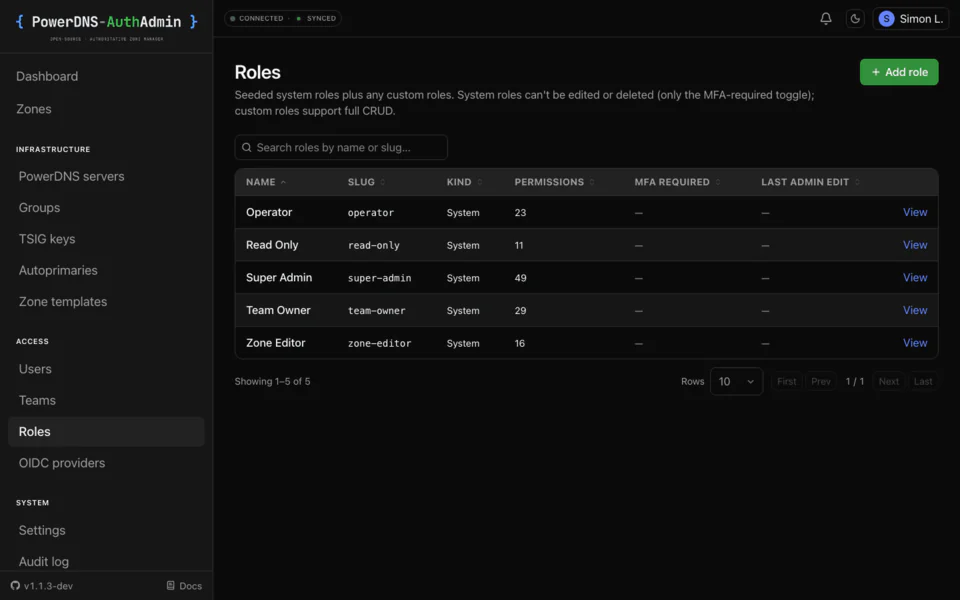
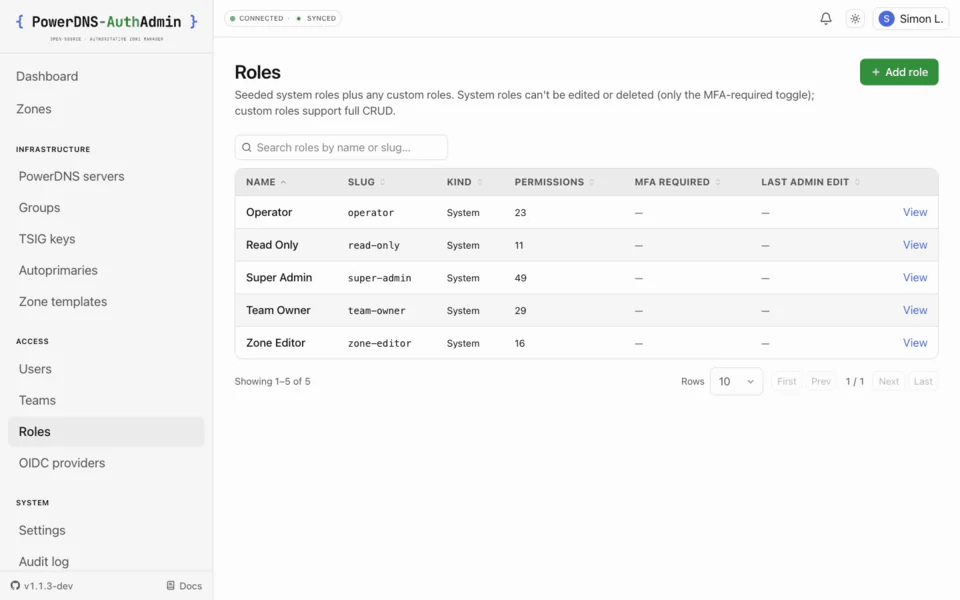
- What. Five system roles are seeded (
super-admin,team-owner,operator,zone-editor,read-only). Custom roles are operator-defined via/admin/roles(gated onrole.create). - Where.
lib/rbac/default-roles.ts,lib/db/schema/roles.ts,app/(app)/admin/roles/. - How. Each role carries
permissions(array of strings from the vocab) +requires_mfa(any user assigned to this role must enrol a second factor - TOTP or a passkey / security key - before they can act).
2.3 Zone-authority permissions#
- What. The SOA, the apex NS RRset, and the zone-settings object are held apart from
ordinary record editing, so a role can be given a zone's records without being given the
zone.
soa.read/soa.updategate the SOA tab;record.update.apex-nsis an extra requirement on top ofrecord.*for writing the apex NS;zone.settings.readgates the Zone settings tab, whose writes stay onzone.update. Missing the read permission removes the tab outright rather than greying it out. - Where.
lib/rbac/protected-rrsets.ts(the classifier both sides share),app/api/admin/pdns/zones/[zoneId]/rrsets/route.ts,app/api/admin/pdns/zones/[zoneId]/settings/route.ts,app/(app)/zones/[zoneId]/page.tsx. - How. The RRset route classifies every change by its normalized name before touching
PowerDNS, so any client - the SOA panel, the record editor, or a hand-rolled
PATCH- gets the same answer. The permissions work as per-zone grants too. See docs/07-RBAC.md.
2.4 Scoped assignments#
- What. Every assignment is
(user, role, scope)where scope is one ofglobal/team:<id>/zone:<fqdn>/server:<id>. The CASL builder walks scopes at request time so an operator withrecord.updateonzone:example.com.can edit records there but nowhere else. Collection views that accept a scoped grant (e.g. the Teams list for a team-scoped Team Owner) opt in withrequireUser({ can, anyInstance: true })and filter every row through an instance check; everything else stays global-only. - Where.
lib/rbac/ability.ts,lib/rbac/policy.ts,lib/db/schema/role-assignments.ts,lib/db/schema/zone-grants.ts. - How. Issue assignments from
/admin/users/<id>(gated onrole.assign), or let IdP group mapping derive them per session (see § 1.3 and § 1.13). Admin-issued assignments and IdP-derived permissions never overwrite each other.
2.5 Per-zone grants and the Access tab#
- What. A
zone_grantsrow gives a user or a team a list of permissions on exactly one(server, zone)- no role needed. Team grants flow to every member throughteam_members, so removing someone from the team revokes the access without touching per-user rows. On a multi-primary cluster a grant on one peer authorizes the zone on every peer, so the rotating peer picker never produces a spurious 403. Every zone-scoped permission in the vocabulary (records, SOA, apex NS, DNSSEC, metadata, zone settings, export) works as a grant, including the authority split from § 2.3. The zone's Access tab (gated onuser.read, since it reveals emails and team membership) lists every principal with access to the zone: roles that carry any zone-scope permission, teams with grants, and users with direct grants. - Where.
lib/db/schema/zone-grants.ts,lib/db/repositories/zone-grants.ts,lib/rbac/zone-permissions.ts(canActOnZone, cluster expansion),app/api/admin/users/[id]/zone-grants/andapp/api/admin/teams/[id]/zone-grants/(+[grantId]),app/(app)/zones/[zoneId]/_components/access-section.tsx. Audit:zone.grant.create|delete. - How. From the Zone grants tab on
/admin/users/<id>(user.update) or the Zone-grants section on/admin/teams/<id>(team.updateon that team), pick a backend, type the zone name (any case, with or without the trailing dot - the route canonicalizes it) and tick permissions. The grant can't exceed what the issuing operator holds themselves.
3. PowerDNS backends#
3.1 Multi-backend management#
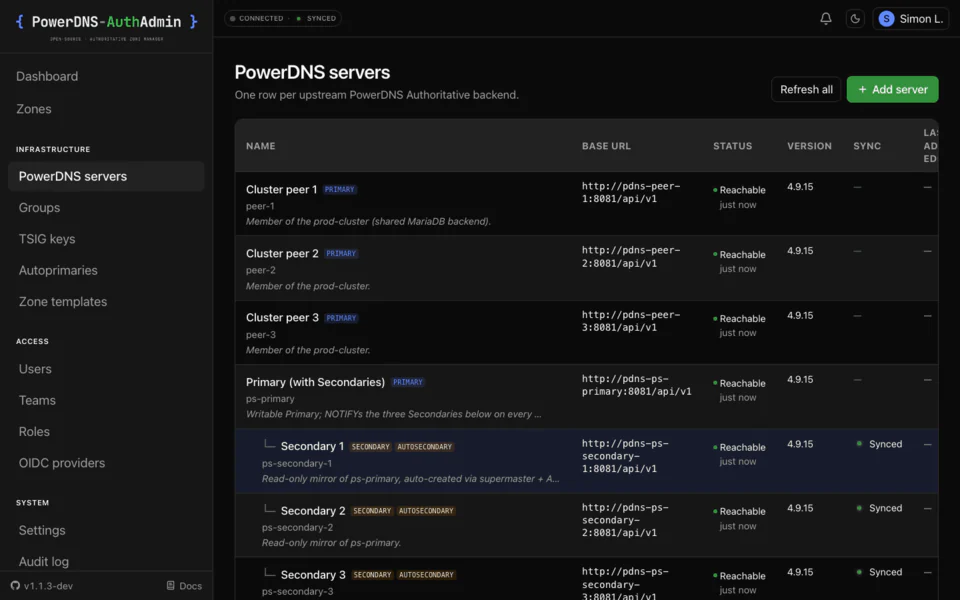
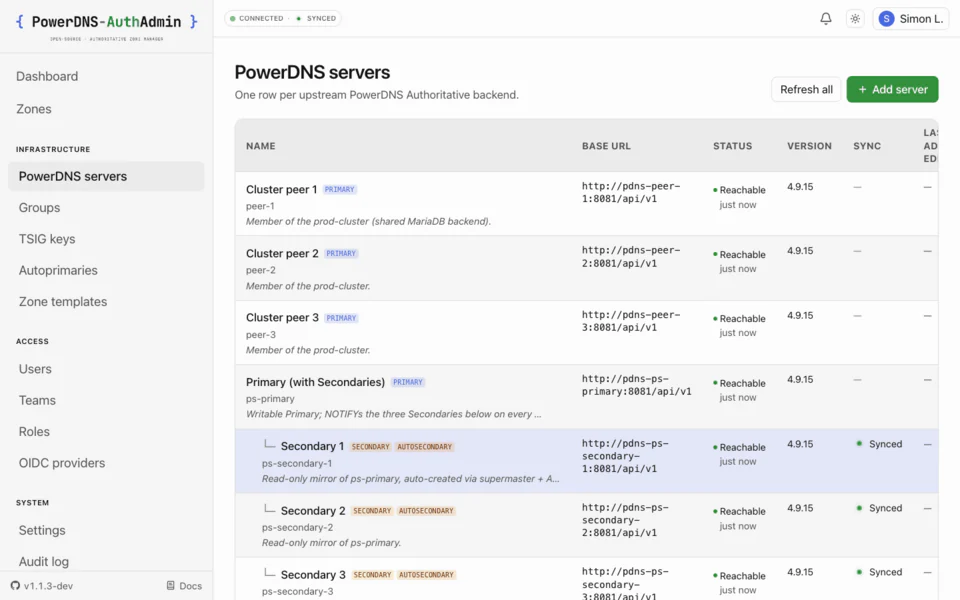
- What. The app fronts one or many PDNS Authoritative servers. Three topologies are
supported and visible side-by-side:
- Standalone primary - single instance, no replication.
- Primary + secondaries - one writable, N read-only mirrors auto-bootstrapped via PDNS supermaster + NOTIFY/AXFR.
- Multi-primary cluster - N writable peers sharing a replicated backend (e.g. Galera MariaDB). Cluster appears as ONE entry in every selector.
- Where.
lib/db/schema/pdns-servers.ts,lib/db/schema/pdns-clusters.ts,lib/db/repositories/{pdns-servers,pdns-clusters,selectable-backends}.ts,app/(app)/admin/{servers,clusters}/.
3.2 Per-cluster peer-selection strategy#
- What. When operating on a cluster, both reads AND writes route to a peer chosen by the
cluster's strategy:
round_robin- spread requests in order.random- uniform random.lowest_latency- peer with the lowest p50 from the sampler (falls back to round-robin until samples exist).least_load- peer with the fewest zones from the sampler.
- Where.
lib/pdns/cluster-picker.ts,lib/pdns/cluster-picker-pure.ts. - How. Picked from the cluster edit page under Peer selection strategy. The column
in the DB is
write_strategy(legacy name preserved); the UI label is "Peer selection strategy" since it governs both reads and writes.
3.3 Read-only backends (write-mode override)#
- What. A per-backend switch, Never write to this backend (read-only), that removes it
from every write path while leaving its zones fully browsable. Peer selection skips it, it
can't be the default backend, and it renders with a
read-onlybadge nested under its group's write target like a mirror. - Why it can't be derived. Every other role signal in the app is observed from the daemon's
/config(ADR-0014). This one can't be: a public nameserver serving native zones fed by database replication runs withprimary=no, secondary=no- byte-identical to a standalone primary - yet its database user has no write access. PowerDNS exposes no flag for that, so without an override the peer picker rotates writes onto it and they fail (#109). - Where.
pdns_servers.write_mode(auto|read_only), theisServerWriteTarget()/isReadOnlyBackend()predicates inlib/pdns/capabilities.ts, enforced inlib/db/repositories/{pdns-servers,pdns-clusters,selectable-backends}.ts. - How. Tick the box on the backend's edit page, or set
write_mode: read_onlyon a server in provisioning YAML. Defaults toauto, so existing backends are unaffected. - Scope. The override governs write routing only. AXFR topology derivation still reads the daemon's real capabilities, so marking a genuine AXFR primary read-only stops writes to it without breaking the secondaries that pull from it. See the 2026-07-22 amendment in ADR-0014.
Note
"Use as the default backend" is a different control - it only picks which backend serves a request that doesn't name one. It has never constrained peer selection within a group; use the read-only switch for that.
3.4 Sync probes#
- What. Two flavours, identical visual shape:
- Primary + secondaries. Compare each secondary's serial against the primary's; on-demand rrset diff for any zone that disagrees. Status chip in the zones table.
- Cluster. Compare every peer's serial against the highest-serial peer (used as source-of-truth on disagreement, since there's no canonical primary). Same rrset diff on demand.
- Where.
lib/pdns/sync.ts,lib/pdns/cluster-sync.ts,app/(app)/zones/[zoneId]/_components/sync-section.tsx.
3.5 NOTIFY-on-write + convergence sweep#
- What. Every code path that creates a zone goes through
createZoneAndNotify()which fires NOTIFY to all secondaries after the create. The provisioning loop additionally runs a convergence sweep after all demo zones are created - re-NOTIFYs every Master/Primary zone on each touched backend. This catches the docker-compose race where the first zones get created before secondaries have registered themselves as supermasters and miss the initial NOTIFY. - Where.
lib/pdns/operations.ts.
3.6 PDNS HTTP client#
- What. Typed thin wrapper over PDNS's HTTP API: zones.list / get / create, rrsets PATCH,
cryptokeys, metadata, TSIG, autoprimaries, server.info, statistics. Version cache +
capability flags so feature gates (catalog zones, DNSSEC) reflect the real backend version.
Retries with backoff, typed error hierarchy (
PdnsError/PdnsNotFoundError/PdnsConflictError). - Where.
lib/pdns/client.ts,lib/pdns/registry.ts,lib/pdns/types.ts,lib/pdns/errors.ts.
3.7 PDNS request log#
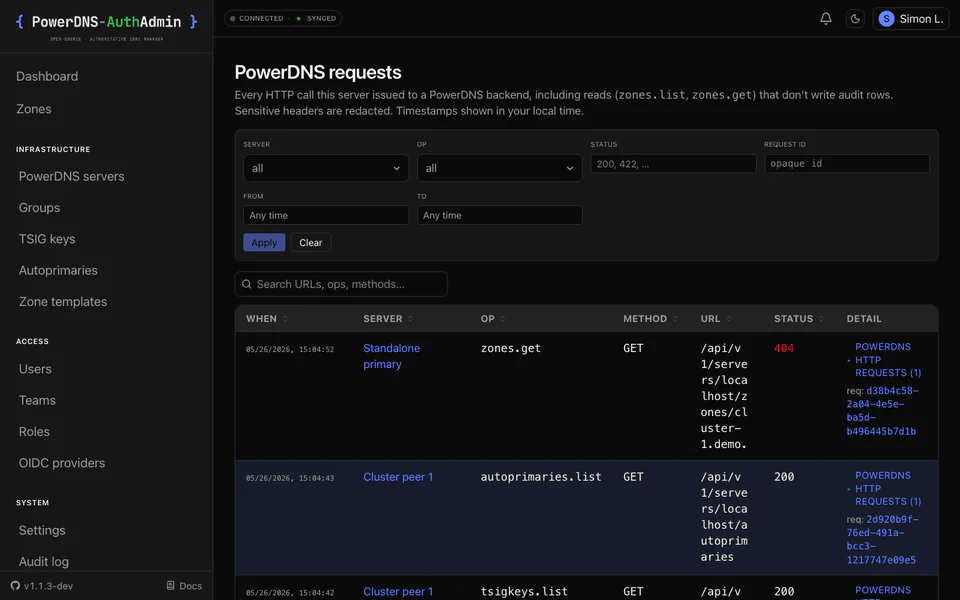
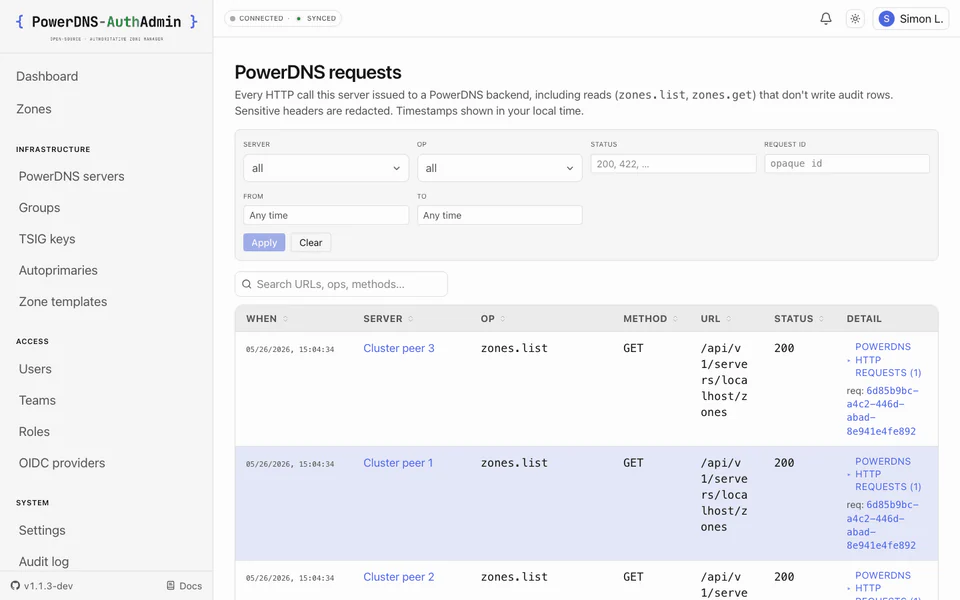
- What. Every HTTP call the app issues to PowerDNS is recorded with timestamp, server,
operation, method, URL, response status, error (if any), and the correlator
requestIdof the audit row that triggered it. Visible at/admin/requestswith filters for server, op, status code, request id, and date range. Each row expands inline to the full request + response detail; thereq:link cross-pivots to / from the matching audit row, so an audit failure is one click from the exact PDNS exchange. - Where.
lib/pdns/request-log.ts,app/(app)/admin/requests/,lib/db/repositories/pdns-requests.ts.
3.8 Backend health advisories#
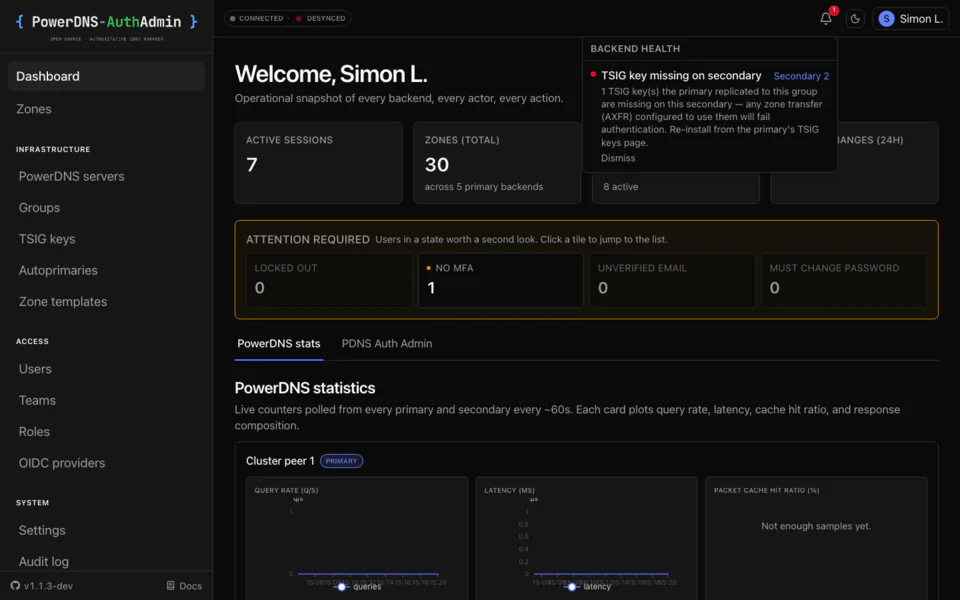
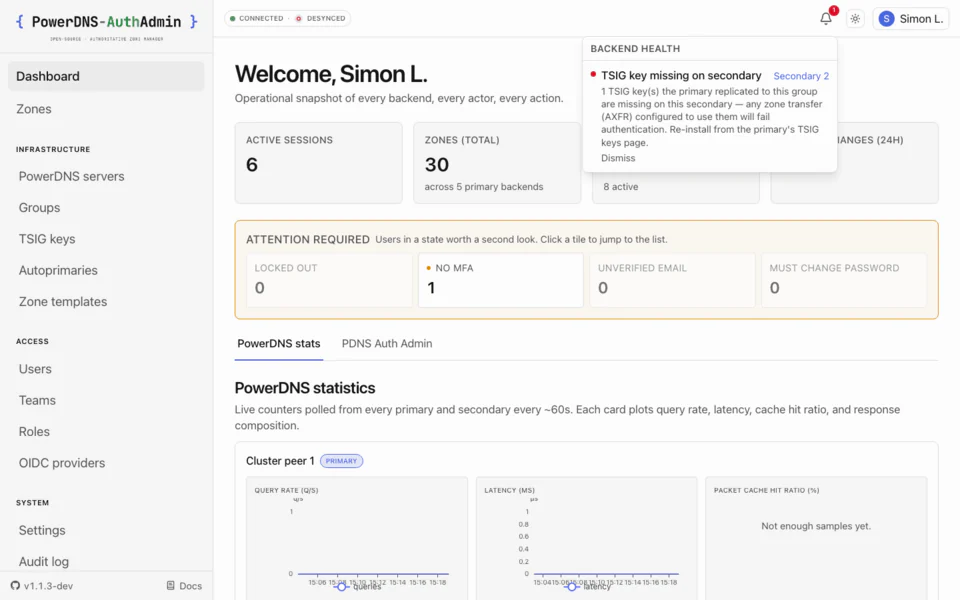
- What. A bell in the top header surfaces active advisories computed every poll cycle:
unreachable backends, API-key rejections (401/403), replication drift past a threshold, TSIG
keys missing on a secondary, mirror zones without
masters, daemon-config drift between peers. Acknowledged advisories disappear automatically when the underlying condition resolves. Same signal feeds the per-row red/warn tints on PowerDNS servers - bell and table never disagree. - Where.
lib/health/evaluator.ts,components/domain/health-bell.tsx,lib/db/repositories/backend-advisories.ts. Decision record: ADR-0015.
3.9 SSRF guard#
- What. Config-time + runtime IP-range checks on PDNS
base_url. Link-local (incl. 169.254.169.254 cloud metadata) is always blocked. Private networks gated byAPP_PDNS_ALLOW_PRIVATE_NETWORKS;http://gated byAPP_PDNS_ALLOW_INSECURE_HTTP. At request time the guard re-resolves the host and pins the validated IP into the connection, so undici reaches the exact address the guard checked (closes the DNS-rebinding window). - Where.
lib/pdns/url-safety.ts(the guard);lib/pdns/http.ts(request-time re-check + pinned dispatcher).
3.10 Observed daemon capabilities#
- What. Each backend carries a capability snapshot derived from its read-only
/configon every daemon-meta probe:api,primary,secondary,autosecondary, thelaunchbackends, DNSSEC, the configured autoprimary count, andenable-lua-records. The active ones render as tinted badges wherever a backend is listed; the allowlisted raw settings show verbatim under Daemon settings on the backend's detail page. - Lua records.
enable-lua-records(no|yes|shared) is in the snapshot because it decides whether the record editor offers theLUAtype at all. LUA records are executable server-side code, so which daemons have it armed has to be visible from the backend list, not discoverable only by opening a zone and looking for the type in a dropdown. A daemon-levelnois not a veto: per-zoneENABLE-LUA-RECORDSmetadata still enables Lua for that one zone. - Freshness. Badges reflect the last probe. After editing
pdns.conf, re-probe the backend (Admin → PowerDNS servers → Refresh) - the same gesture that refreshes every other capability. - Where.
lib/pdns/capabilities.ts,lib/pdns/config-advice.ts,components/domain/capability-badges.tsx,lib/realtime/backend-health.ts. See ADR-0014.
4. Zones#
4.1 Amalgamated zones list#
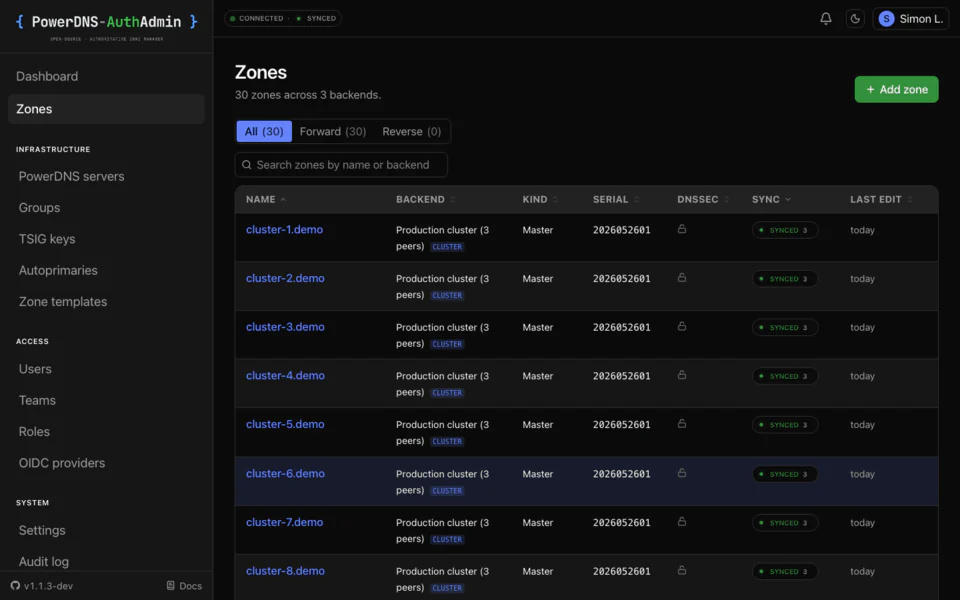
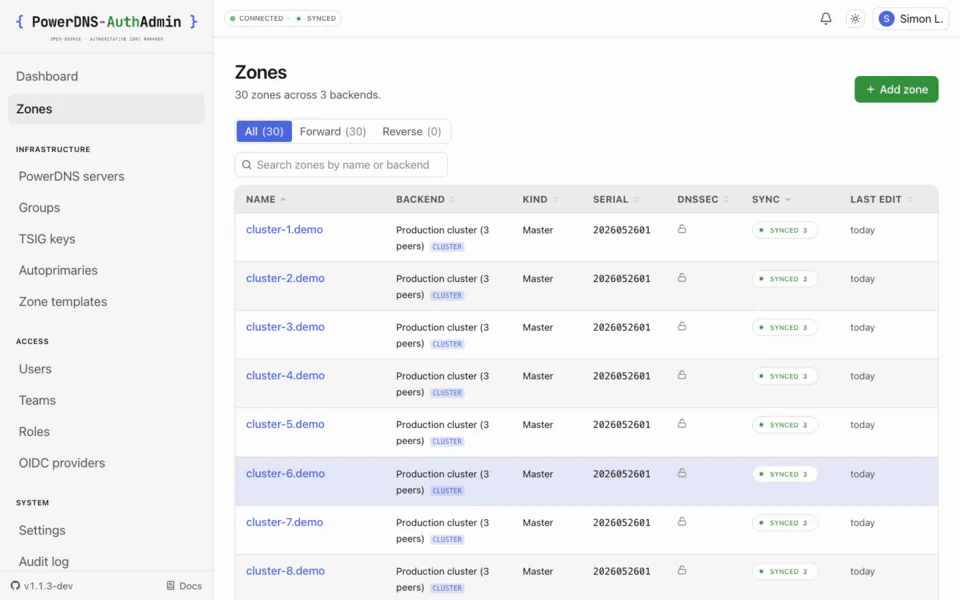
- What. Every zone across every backend in one list. Per-row "Backend" column. Per-row Sync chip: "-" for standalones, "synced/desynced (N)" for primaries with secondaries and for clusters.
- One row per zone identity -
(horizon, name), see § 4.1.1. The same zone reached from a primary and its mirrors collapses to one row, resolved to the backend that owns it; anything genuinely collapsed is summarized in the "duplicate zones hidden" notice. - Where.
app/(app)/zones/page.tsx,app/(app)/zones/_components/zones-table.tsx,lib/dns/zone-dedupe.ts.
4.1.1 Split-horizon zones (public / internal)#
- What. A per-zone horizon - "this is the internal copy" - set with a toggle at create time
or later on the zone's Zone settings tab. An internal zone lists separately from a public zone
of the same name, carries an
INTERNALbadge next to theCLUSTERbadge, and shows the badge on its detail page so it's unambiguous which copy is open before anyone edits a record. A Public / Internal filter appears above the list once the fleet has at least one internal zone. - Why. Split-horizon DNS serves the same name differently inside and outside the network, usually from two daemons. Before this, the list keyed on the name alone, so the internal copy vanished into the "duplicate zones hidden" notice - a deliberate setup reported as an accident of replication (#121).
- How. App-side classification (PowerDNS cannot tell the two apart), stored sparsely in
zone_horizonsand scoped to the backend - to the cluster for a cluster zone, so it doesn't flicker as peer selection rotates. Unclassified meanspublic, so nothing changes for installs that don't use it. A mirror of a managed primary inherits that primary's classification. Changes are audited aszone.horizon.update; deleting a zone drops its classification. - Scope. Presentation and grouping only - it never changes what PowerDNS serves, and it is not PDNS 5.0 Views (which splits horizons within one daemon; complementary, not superseded).
- Where.
lib/dns/zone-horizon.ts,lib/dns/zone-dedupe.ts,lib/db/{schema,repositories}/zone-horizons.ts,components/domain/zone-horizon-badge.tsx. See ADR-0022.
4.2 Per-RRset editor with diff-before-apply#
- What. Edit records inline; the editor batches changes into a single transactional PATCH to PDNS with an audit row carrying full before/after JSONB snapshots. Every change runs through a Review changes modal that previews the BIND-style before/after diff - Save is the second click, never the first.
- Default TTL. A new record starts with the zone's
X-AUTHADMIN-DEFAULT-TTLmetadata if set, else thedefault_record_ttlsetting, else 3600. The TTL field says which one applied. The per-zone value lives in PowerDNS metadata, so it's set from the zone's Metadata tab (metadata.write, audited) or seeded on new zones by a template's metadata bag (lib/dns/default-ttl.ts). - Where.
app/(app)/zones/[zoneId]/_components/editable-record-table.tsx,app/api/admin/pdns/zones/[zoneId]/rrsets/route.ts. - How. Per-RR-type validators live in
lib/validators/rr-types/and run on every change pair. Hard-error for shape/range violations; soft-warn for deprecated-but-legal options (DS digest-type 1, SSHFP DSA, SVCB unknown SvcParamKey, etc.). Hard errors are gated by an explicit Save anyway checkbox so an override is always intentional and audited verbatim.
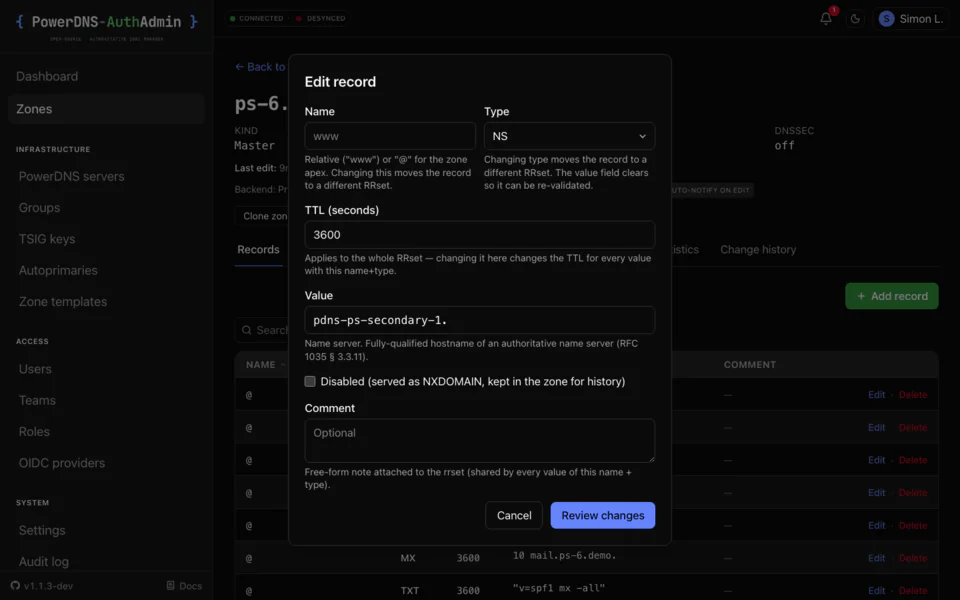 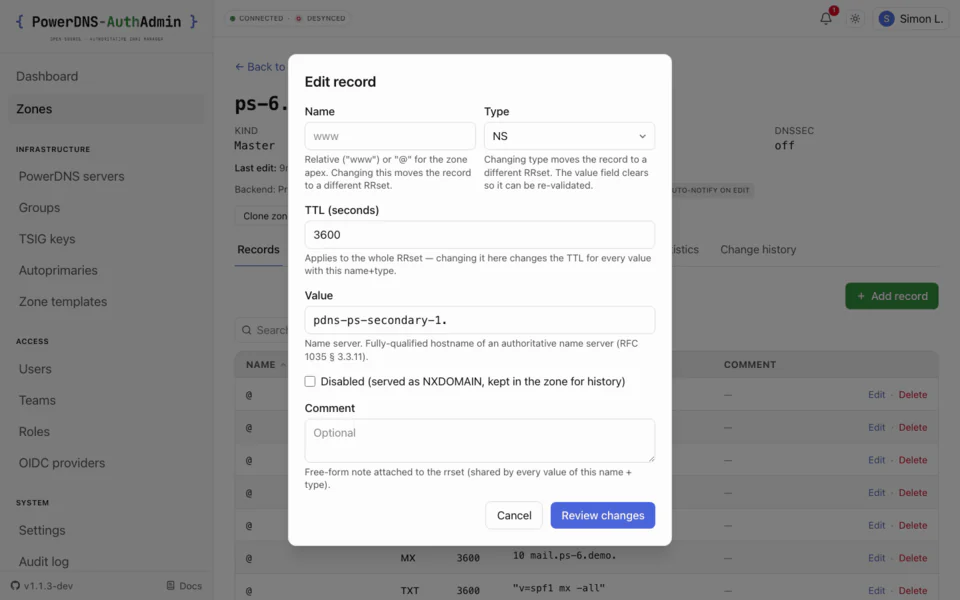 Edit dialog - Name / Type / TTL / Value with per-type structured editors. |
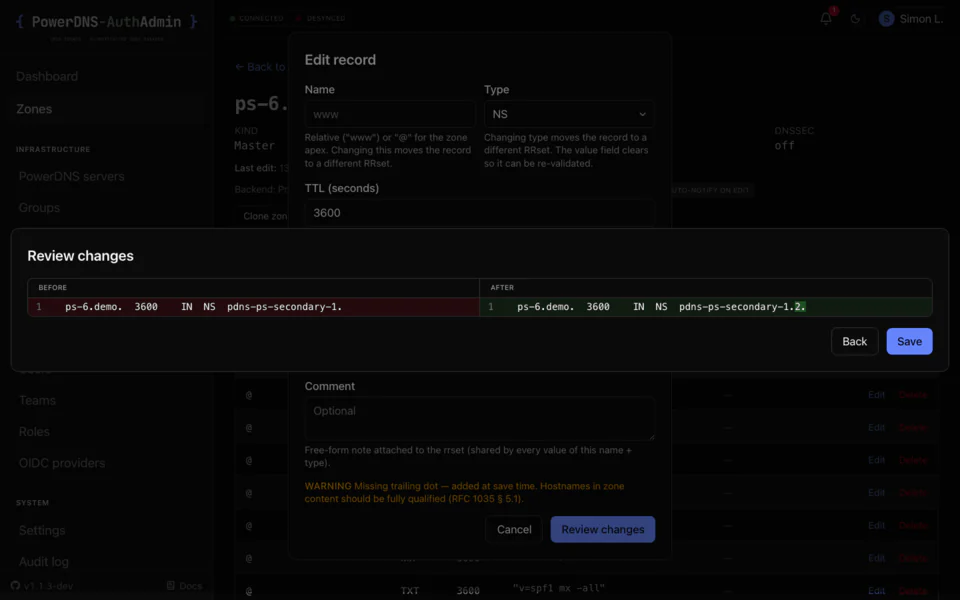 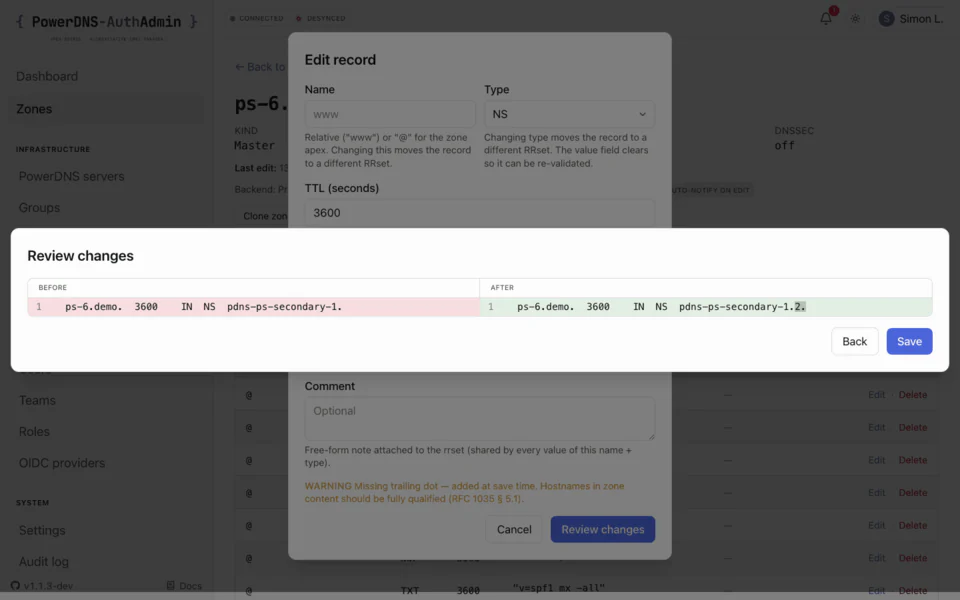 Review changes - every save previewed as a before/after diff. |
4.3 Zone clone#
- What. Copy a zone's rrsets into a new zone name on the same backend. The new zone ships with the original's records (sans SOA, which PDNS regenerates).
- Where.
app/api/admin/pdns/zones/clone/route.ts,lib/pdns/clone.ts.
4.4 Zone templates#
- What. Reusable scaffolding for new zones: NS records, SOA timers, prelude records,
zone-object settings (
soa_edit,soa_edit_api,api_rectify), per-kind metadata bag. Templates can bedefault_for_primary_slugsso the create-zone form preselects them when the operator picks one of the listed backends. - Where.
lib/db/schema/zone-templates.ts,lib/validators/zone-templates.ts,app/(app)/admin/zone-templates/.
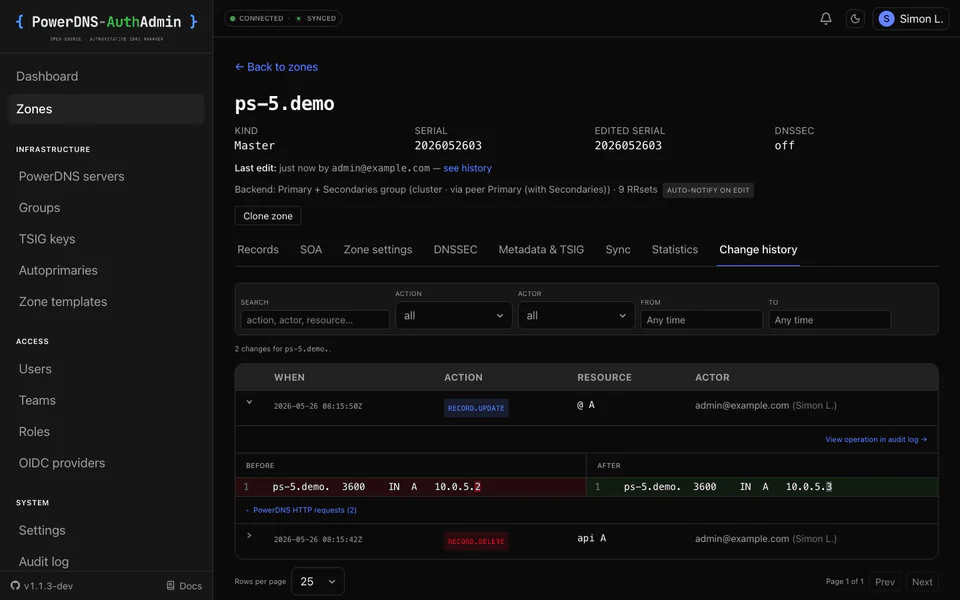
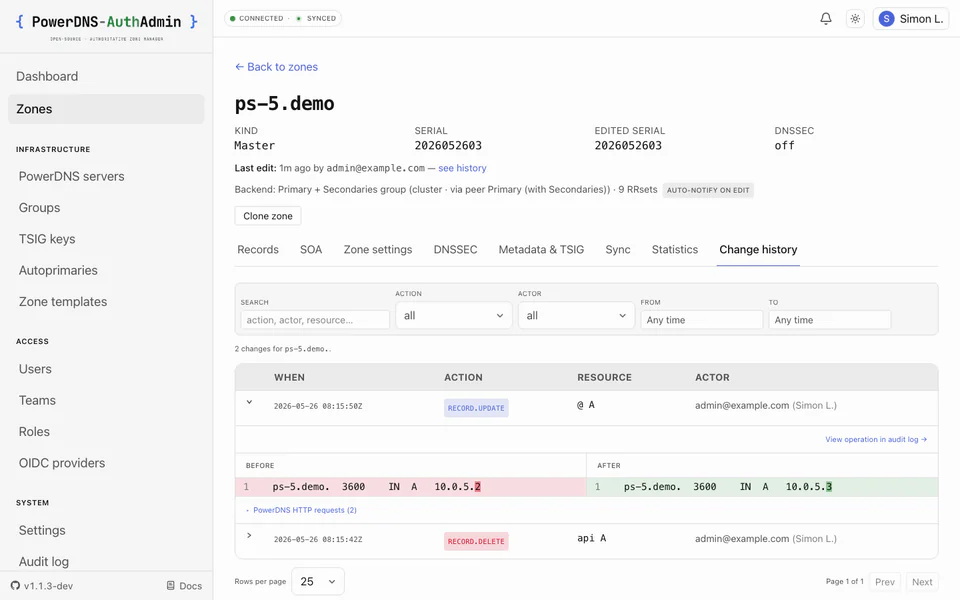
4.5 Zone change history#
- What. Per-zone history feed at
/zones/<id>?tab=historyrendering every audit event with diff (rrset before/after) and one-line summaries for DNSSEC / metadata events. Chip colours match the action vocabulary's tone (lib/audit/action-color.ts). - Where.
app/(app)/zones/[zoneId]/_components/zone-change-log.tsx.
4.6 Zone import / export (BIND zonefiles)#
- What. An Import / Export hub at
/admin/import-export(sidebar: PowerDNS → Zones). Import takes one or many zones in BIND format, pasted or uploaded (2 MiB cap): the RFC 1035 parser splits multi-zone input at$ORIGINboundaries, handles$TTL,@, comments and parenthesised multi-line SOAs, refuses$INCLUDE(file-traversal vector) and skips DNSSEC types (PowerDNS owns those). Each zone becomes onecreateZonecall with its rrsets pre-populated; failures are reported per zone instead of aborting the batch, and a TSIG key can be attached to imported Master zones in the same pass (§ 7). The Lua gate (§ 4.7) applies to importedLUArecords. Export picks a backend and any number of zones and downloads a single BIND bundle ($TTL,$ORIGIN, owner names relativised, the apex as@); the per-zoneGET /api/admin/pdns/zones/[zoneId]/exportreturns<zone>.zoneand is what the delete dialog uses to force a backup download first. Output round-trips through BIND, NSD andpdnsutil load-zone. - Where.
app/(app)/admin/import-export/,app/api/admin/pdns/zones/{import,export}/,app/api/admin/pdns/zones/[zoneId]/export/,lib/dns/zonefile-parser.ts,lib/dns/zonefile-formatter.ts,lib/dns/zonefile.ts. Audit: onezone.create(after.source: zonefile-import) per imported zone, onezone.exportper exported zone. - How.
zone.readopens the hub and exports;zone.createimports. Thezone.import/zone.exportpermissions in the vocabulary are reserved for finer-grained gating and are held by Operator and above.
4.7 Lua records#
- What. The editor offers - and the write path accepts - the PowerDNS
LUAtype only when the daemon actually has Lua armed: the globalenable-lua-recordssetting or the zone'sENABLE-LUA-RECORDSmetadata. The check is re-read live from PowerDNS on every Lua write (RRset PATCH and zonefile import alike) and fails closed, so a stale tab or crafted request can't land executable records on a server that has Lua off. The content validator checks the presentation format (<query-type> "<snippet>", adjacent quoted chunks,\DDDescapes, the 255-octet boundary) without attempting to parse Lua. Which backends have Lua armed is visible from the capability badges (§ 3.10); the DNSSEC tab warns about Lua records on replicated signed zones (§ 5). - Where.
lib/pdns/lua-enablement.ts,lib/pdns/metadata-policy.ts,lib/validators/rr-types/lua.ts.
5. DNSSEC#
- What. Zone-level Enable / Disable DNSSEC and Rectify, plus cryptokey create /
update / delete with per-key activity timestamps derived from the audit log. Enable does
PowerDNS' own
PUT /zones/{id}withdnssec: true(default keys + rectify + serial bump), sets API-RECTIFY and, for a transferred zone, SOA-EDITINCREMENT-WEEKSso presigned secondaries re-transfer fresh signatures weekly, then NOTIFYs. Adding a single key also rectifies. Disable is confirm-gated (confirm=<zone>) and keeps SOA-EDIT. The tab shows signing state, NSEC/NSEC3, SOA-EDIT, the DS set to publish, and warnings (missing SOA-EDIT, LUA/ALIAS records on a replicated zone). Status, keys and DS are readable over the API for PAT clients. All changes are audited (dnssec.enable|disable|rectify,dnssec.cryptokey.*). - Sync semantics. Mirrors are compared against the primary's served serial
(
edited_serial), not the stored one, so SOA-EDIT zones don't read as desynced (#146). A mirror behind only on the weekly SOA-EDIT rollover is "refresh due" for one SOA refresh. The record diff masks the SOA serial and, for signed zones, skips the DNSSEC records a presigned mirror stores. - Where.
app/(app)/zones/[zoneId]/_components/dnssec-section.tsx,app/api/admin/pdns/zones/[zoneId]/{dnssec,rectify,cryptokeys}/,lib/pdns/dnssec-plan.ts,lib/pdns/serial-sync.ts,lib/pdns/zone-diff.ts. Operator guide: 04-BACKENDS § DNSSEC.
6. Zone metadata#
- What. Per-kind GET / PUT / DELETE under
/api/admin/pdns/zones/[zoneId]/metadata/[kind]. Surfaced as<MetadataEventLine>entries on the zone change-history feed. AuthAdmin's ownX-AUTHADMIN-*kinds are validated before they're written (normalizeMetadataValuesinlib/pdns/metadata-policy.ts). - Where.
app/(app)/zones/[zoneId]/_components/metadata-section.tsx,app/api/admin/pdns/zones/[zoneId]/metadata/.
7. TSIG keys#
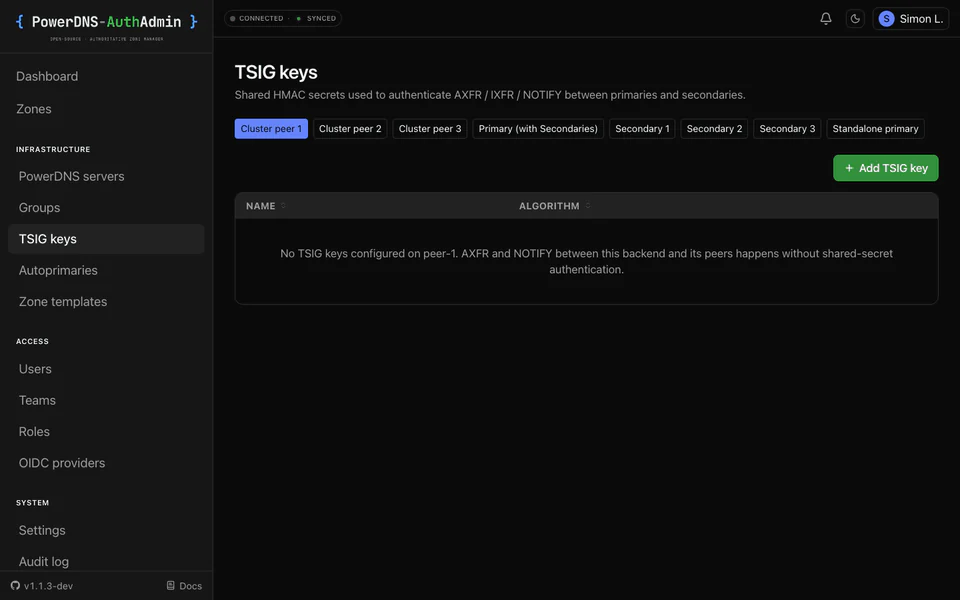
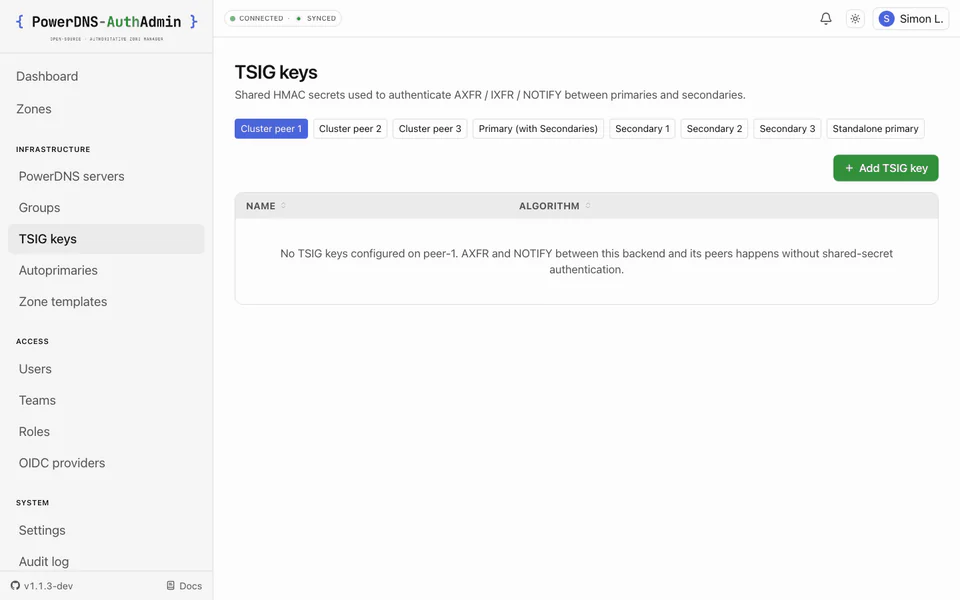
- What. Manage shared-secret keys for AXFR + DDNS. Permission model splits
tsig.read(list-only - name + algorithm) fromtsig.manage(create / regenerate / reveal / delete) so an operator can audit the inventory without ever seeing the secret material. - Replication helpers.
- Install on secondaries -
POST /api/admin/pdns/tsig-keys/[id]/installfetches the key server-side and POSTs it to each of the primary's secondaries over their TSIG API; the secret never reaches the browser. Version-gated (supportsTsigApi): older daemons reportunsupported, and a key with the same name but a different secret is reported, not overwritten. Audittsig.install-secondaries. - Manual install script -
POST .../manualreturns a copy-paste script (pdnsutil import-tsig-key+set-meta) for daemons without the TSIG API or air-gapped boxes. It contains the secret, so it's returned astext/plainand audited astsig.manual-reveal. - Zone transfer key -
POST /api/admin/pdns/zones/[zoneId]/tsig-transferadds or removes a key on both ends at once:TSIG-ALLOW-AXFRon the primary's copy andAXFR-MASTER-TSIGon each secondary that hosts the zone (additive, so other keys stay). Gated onmetadata.writelike the raw metadata route; audited aszone.tsig-transfer.set. The create-zone and import forms expose the same choice - a key is selectable only when it exists on the primary and every participating secondary (lib/realtime/tsig-eligibility.ts).
- Install on secondaries -
- Where.
lib/pdns/tsig.ts,lib/pdns/tsig-install.ts,lib/realtime/tsig-replication.ts,app/api/admin/pdns/tsig-keys/,app/(app)/admin/tsig-keys/.
8. Autoprimaries#
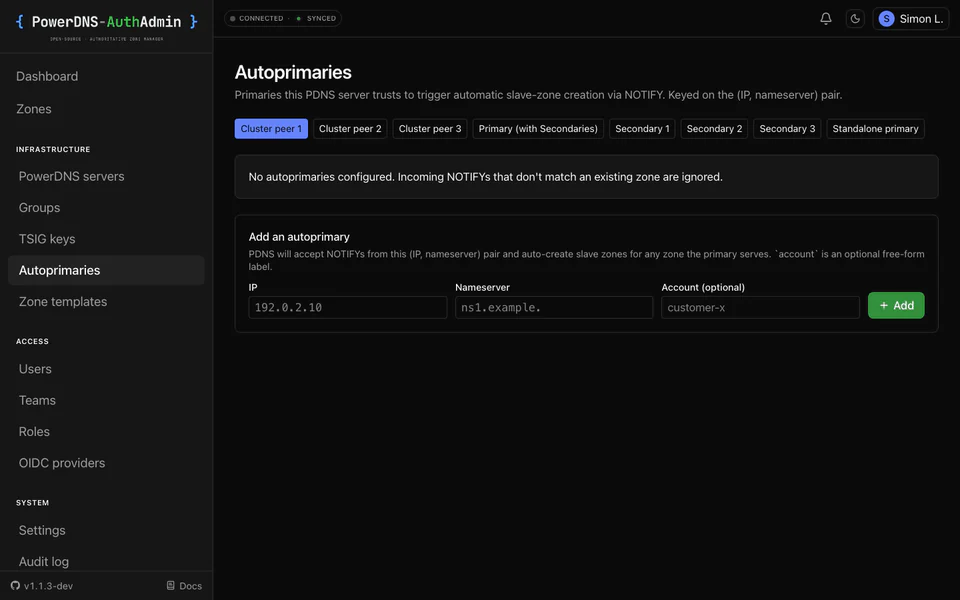
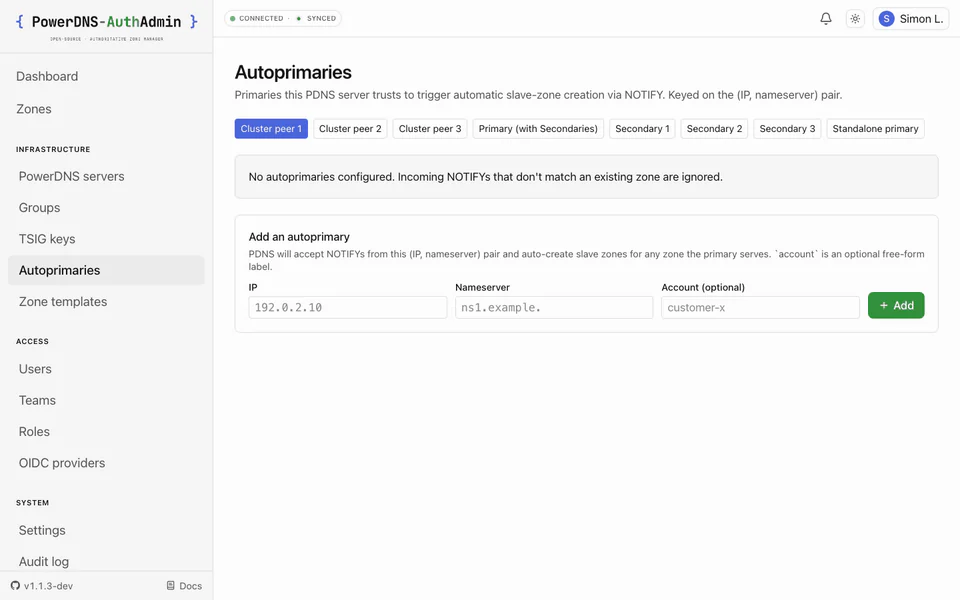
- What. Configure supermaster registrations on a secondary PDNS so it auto-creates zones
on NOTIFY from a registered primary. Gated on
autoprimary.manage; audited asautoprimary.create|delete. - Where.
lib/pdns/types.ts(autoprimary schemas),lib/pdns/client.ts,app/api/admin/pdns/autoprimaries/,app/(app)/admin/autoprimaries/.
9. Audit log#
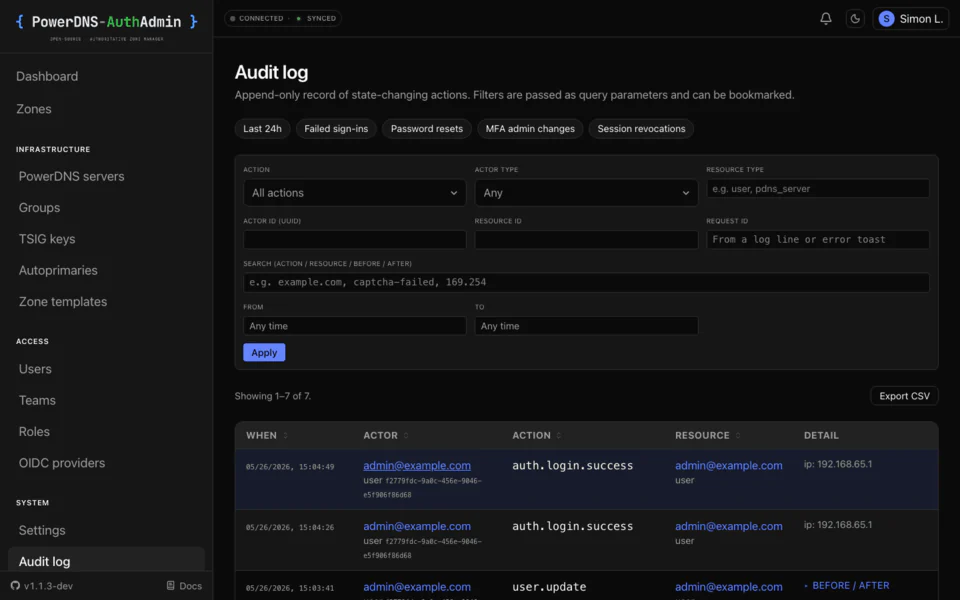
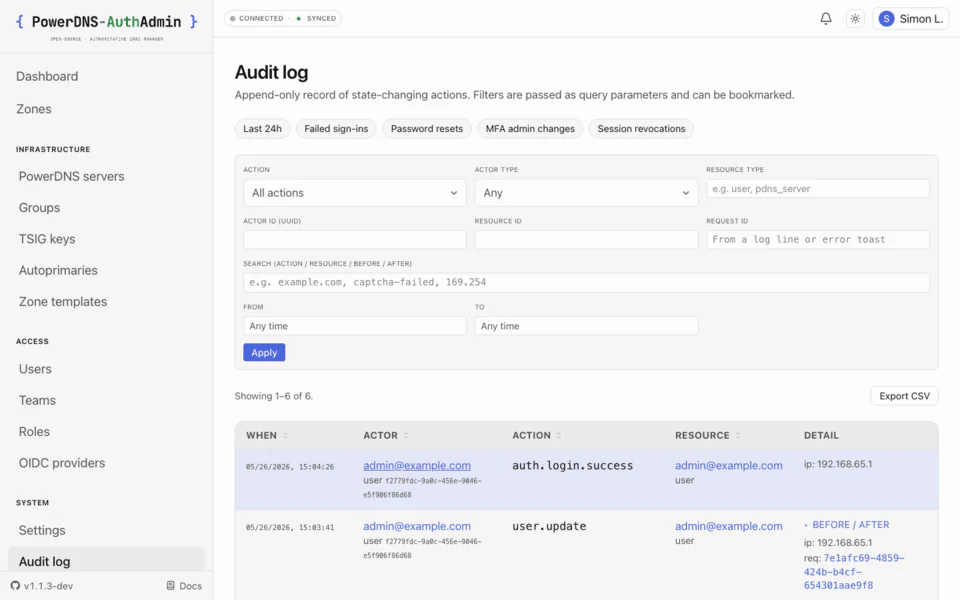
- What. Append-only log of every state-changing operation. Each row carries actor, action, resource, optional before/after JSONB snapshots, request context (IP, user-agent, request id), and a timestamp. Snapshots are auto-redacted for known secret field names.
- Where.
lib/audit/log.ts,lib/audit/actions.ts(typed vocab),lib/audit/redact.ts,app/(app)/admin/audit/. - How. Filter by actor, action, resource, time range from
/admin/audit(gated onaudit.read). Per-resource "Last admin edit" columns on every admin list page are derived from one batched query. Quick-filter chips cover the common incident-response queries (failed sign-ins, MFA admin changes, session revocations). Every row that originated a PDNS call carries areq:link that pivots to the matching rows in the PDNS request log, and CSV export honours the active filters.
9.1 Audit action vocabulary#
Every row's action is one of the strings below (lib/audit/actions.ts is the source of
truth; add there first). Names follow <resource>.<verb> and line up with the permission
vocabulary where a 1:1 mapping exists. Rows written before a rename keep the old name.
| Action | Written when |
|---|---|
auth.login.success | A sign-in completed (any method; after.method is local, oidc, saml, ldap, webauthn-primary or webauthn-second-factor, after.provider the slug). |
auth.login.failure | A sign-in was refused - bad credentials, lockout, captcha missing/failed, unverified email, MFA step failed. |
auth.logout | A session was ended by its owner. |
auth.password.changed | A user changed their own password. |
auth.mfa.enrolled | TOTP enrolled on the actor's own account. |
auth.mfa.removed | TOTP removed (self-service, or by an admin - actor tells which). |
auth.mfa.webauthn.enrolled | A passkey / security key was registered. |
auth.mfa.webauthn.removed | A passkey / security key was deleted. |
auth.mfa.webauthn.renamed | A passkey / security key was given a new label. |
auth.session.revoked | A user revoked one of their own sessions from /profile. |
auth.token.issued | An API token was created (after carries prefix, scopes, expiry - never the secret). |
auth.token.revoked | An API token was revoked. |
auth.idp.linked | Reserved in the vocabulary - not emitted today; an SSO first sign-in that provisions a user writes user.create. |
auth.idp.rejected_provisioning | An SSO sign-in was refused before a user row was created (email domain not allowed, unverified email, disabled account). |
auth.signup.rejected | A self-service signup was refused by the email-domain allow-list (after carries the domain only). |
auth.password.reset.requested | A forgot-password request matched a real user and a reset token was minted. |
auth.password.reset.completed | A reset token was redeemed and the password replaced (sessions revoked). |
auth.password.reset.invalid | A reset token was rejected (expired, already used, bad signature). |
auth.email.verify.sent | A verification token was minted for a user. |
auth.email.verify.completed | An address was verified (email_verified_at set). |
auth.email.verify.invalid | A verification token was rejected. |
auth.email.change.requested | A user asked to move their account to a new address (token bound to the new email). |
auth.email.change.completed | The new address was confirmed and swapped in. |
auth.email.change.invalid | An email-change token was rejected. |
auth.group_sync.mapping_unresolved | A group → role mapping named a role / team / server that no longer exists; the mapping was skipped (after.provider). |
auth.token.idp_perms_refreshed | An API token triggered a live IdP group re-fetch (one row per IDP_PERMS_CACHE_TTL_SECONDS window). |
user.create | A user was created by an admin, by signup (after.source: signup) or by SSO auto-provisioning. |
user.update | Profile fields, flags or MFA requirement changed by an admin. |
user.disable | An account was disabled. |
user.enable | Reserved in the vocabulary - not emitted today; re-enabling is written as user.update (the PATCH route only splits out user.disable). |
user.delete | An account was deleted. |
user.password.reset | An admin issued a temporary password (the reveal is a separate one-time read). |
user.session.revoked | An admin revoked one session of another user. |
user.sessions.revoked | An admin revoked every session of one user. |
user.sessions.revoked_all | An admin revoked every session in the system (/api/admin/sessions). |
team.create / team.update / team.delete | Team lifecycle. |
team.member.added / team.member.removed | Team membership changed. |
role.create / role.update / role.delete | Role lifecycle (permissions, requires_mfa, description). |
role.assignment.created / role.assignment.deleted | A (user, role, scope) assignment was issued or removed by an admin. |
settings.write | One or more settings changed on /admin/settings (before/after per key). |
audit.export | The audit log was exported as CSV (filters in after). |
| `oidc.provider.created | updated |
oidc.provider.refresh-all | Operator re-probed discovery for every enabled OIDC provider (one row per click). |
| `saml.provider.created | updated |
| `ldap.provider.created | updated |
pdns_server.refresh-all | Operator re-probed every active backend's version / capabilities (one row per click). |
backend_advisory.acknowledge | An operator dismissed a health-bell advisory; the condition stays monitored. |
zone.create | A zone was created - UI, API, clone, template, import (after.source) or provisioning. |
zone.update | Reserved in the vocabulary - not emitted today; zone-object changes are written as zone.settings.update. |
zone.delete | A zone was deleted (and its horizon classification dropped). |
zone.notify | A NOTIFY was sent to the zone's secondaries (explicit, or as part of a write). |
zone.metadata.set / zone.metadata.delete | A metadata kind was written or removed. |
zone.settings.update | Kind, masters, SOA-EDIT(-API) or API-RECTIFY changed on the Zone settings tab. |
zone.horizon.update | A zone was reclassified public ↔ internal (§ 4.1.1). |
zone.grant.create / zone.grant.delete | A per-zone grant was issued to or removed from a user or team (§ 2.5). |
zone.export | A zone was rendered as a BIND zonefile for download. |
zone.tsig-transfer.set | The zone's AXFR TSIG key was added or removed on primary + secondaries. |
| `dnssec.cryptokey.create | update |
dnssec.enable / dnssec.disable / dnssec.rectify | Zone-level signing state changed or the zone was rectified (§ 5). |
record.create / record.update / record.delete | An RRset changed (before/after snapshots; DynDNS updates are record.update with after.source: dyndns). |
tsig.create / tsig.delete | TSIG key lifecycle. |
tsig.reveal | A key's secret was shown to an operator. |
tsig.install-secondaries | A key was copied to the primary's secondaries over the TSIG API. |
tsig.manual-reveal | The pdnsutil install script (containing the secret) was generated. |
autoprimary.create / autoprimary.delete | Autoprimary (supermaster) registration changed. |
| `template.create | update |
server.create / server.update / server.delete | PowerDNS backend lifecycle (API key redacted). |
server.cluster.assigned / server.cluster.removed | Reserved in the vocabulary - not emitted today; a group change is a server.update whose before/after carries clusterId. |
cluster.create / cluster.update / cluster.delete | Group / cluster lifecycle (peer-selection strategy). |
provisioning.applied | First-boot provisioning finished (after carries per-block counts). |
provisioning.skipped | The file was present but the provisioned_at sentinel already existed. |
provisioning.failed | The applier aborted (the boot fails too). |
system.backup.exported | The app-DB JSON backup was downloaded (after carries row counts per table). |
system.backup.restored | A backup was merged into the database (after carries inserted counts per table). |
10. Settings#
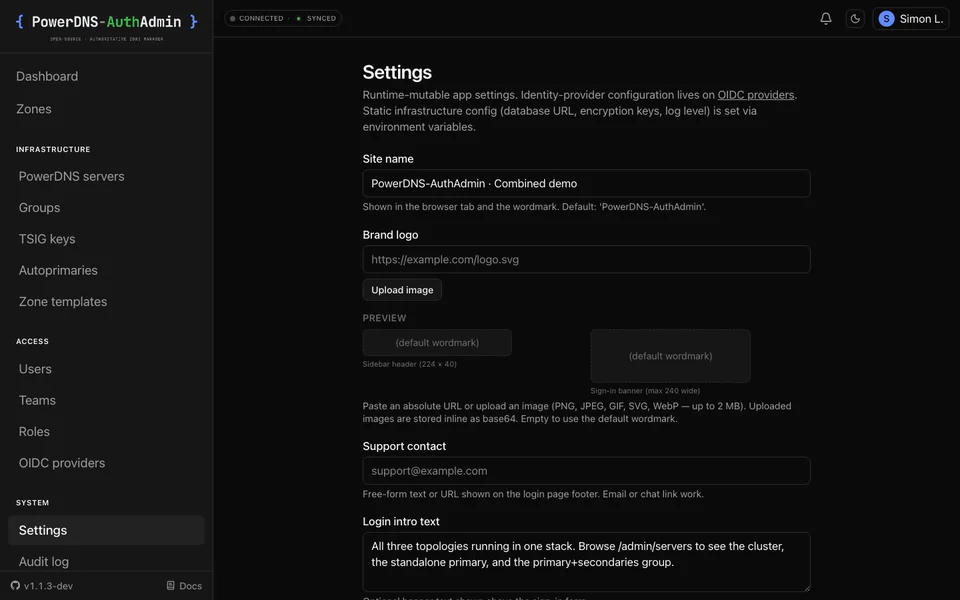
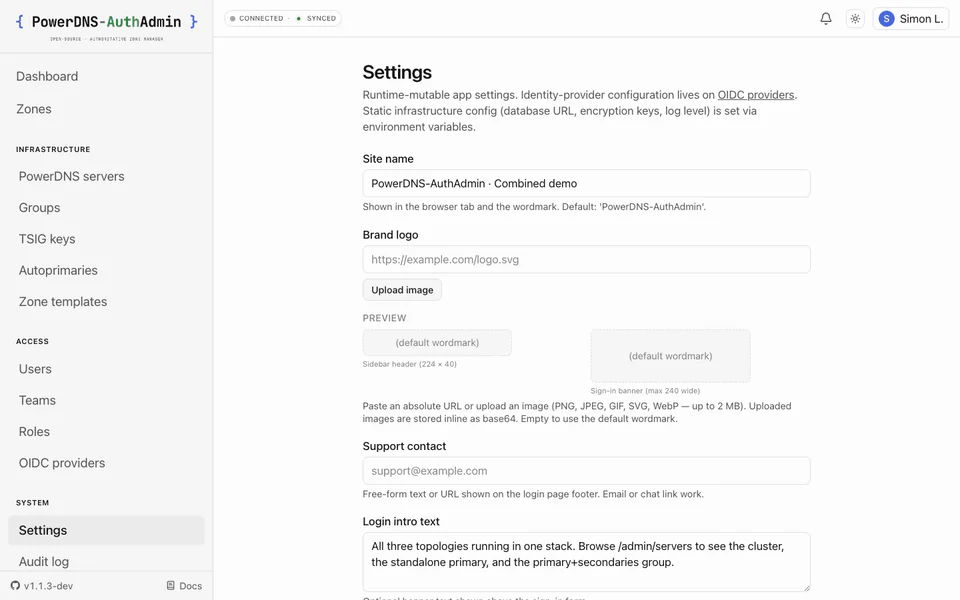
- What. Operator-tunable runtime values: site name, support contact, login intro text,
brand logo (https:// URL or inline data: URI), failed-login lockout policy, the
self-service password-reset toggle (
allow_password_reset), the default sign-in method (auth_default_provider, edited from/admin/authentication), and the default TTL for new records (default_record_ttl, overridable per zone - see § 4.2).SETTINGS_RO=truefreezes the whole page (§ 17.1). - Where.
lib/validators/settings.ts,app/(app)/admin/settings/,lib/settings/app-settings.ts.
10.1 Backup & Restore#
- What. A super-admin wizard at
/admin/settings/backup(every step inline, with a back button). Export streams a JSON dump of the app database - users, roles, assignments, teams, grants, tokens, providers, backends, clusters, templates, settings, advisories, the audit log - as{ meta, tables }. It deliberately excludes PowerDNS zone data (the daemon owns it) and the symmetric secrets (APP_SECRET_KEY/APP_ENCRYPTION_KEY, which stay in the environment); encrypted columns export as ciphertext, so the file is useless without the encryption key and safe to store next to the database. Restore is merge-mode only: every row is inserted withON CONFLICT DO NOTHINGin forward-FK order inside one transaction, guarded by a typedRESTOREconfirmation, so it adds missing rows and never overwrites existing ones. The restore target must share the source'sAPP_ENCRYPTION_KEY.SETTINGS_RO=trueblocks both directions (§ 17.1). - Where.
app/(app)/admin/settings/backup/,app/api/admin/backup/{export,restore}/,lib/auth/settings-lock.ts. Permission:system.backup, default-granted only to the seeded Super Admin role. Audit:system.backup.exported|restoredwith per-table row counts. - How. For a true wipe-and-restore, or for PowerDNS zone data, use
pg_dump/sqlite3 .backupand your PowerDNS backend's own backups - see 02-INSTALLATION → Backups.
11. Dashboard#
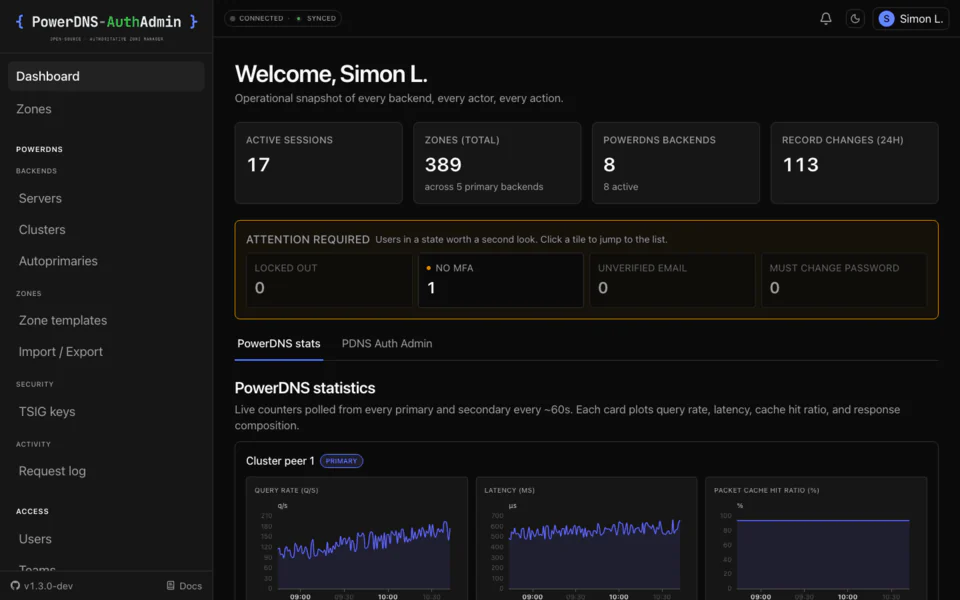
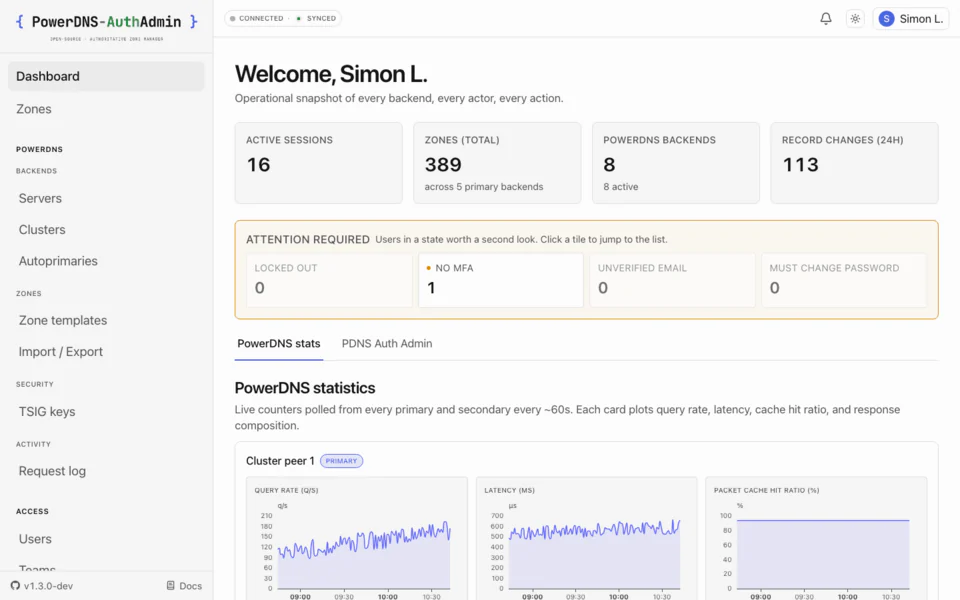
What. At-a-glance widgets for operator attention surfaces:
- Users - locked-out, no-MFA, unverified, must-change-password counts.
- PDNS backends - never probed, stale > 24h.
- OIDC providers - never probed, failing discovery.
Widgets are hidden when zero, so the dashboard stays quiet during steady-state.
PowerDNS metrics tab. With
PDNS_BACKGROUND_POLLING=true, a second tab charts each backend's/statisticsover time - query rate, latency, cache hit ratio, response composition by qtype / rcode / size - from thepdns_server_statstime-series the poller samples every ~60 s (plus a 5-minute snapshot). Counter metrics are plotted as per-second rates, map metrics as donuts. Retention is pruned on the same cadence, bounded to the window the dashboard reads. With polling off the tab is hidden and the heading carries an(i)hint naming the env var.Where.
app/(app)/dashboard/page.tsx,lib/db/repositories/dashboard.ts,lib/metrics/{pdns-stats-sampler,dashboard-windows,retention}.ts,components/domain/pdns-stat-chart.tsx; sampling lives inlib/realtime/zone-poller.ts.
12. Provisioning (first-boot YAML)#
- What. A YAML file applied on first boot writes the operator's declarative state into the
database: settings, custom roles, teams, zone templates, PDNS clusters, PDNS servers, OIDC /
SAML / LDAP providers (each with group mappings), and demo zones - applied in that order.
Role entries whose slug is a seeded system role are refused rather than overwritten. The
applier writes a
settings.provisioned_atsentinel on success; subsequent restarts skip the file. - Where.
lib/provisioning/schema.ts(Zod schema),lib/provisioning/apply.ts,provisioning.example.yaml(exhaustive reference). - How. Set
PROVISIONING_FILE=/etc/.../provisioning.yamlin the env, drop the file at that path, restart. To re-provision an existing database, delete thesettings.provisioned_atrow and restart.
13. Email / SMTP#
- What. Optional transactional mail. With
SMTP_HOSTunset,sendEmail()no-ops with{ ok: true, skipped: true }; the email-verification and email-change flows then record their link on the audit row (after.url) for an operator to pass on, while the password-reset flow prints its link once in the server log (warn level) and never stores it in the audit log - the admin Reset password action on/admin/users/<id>is the supported alternative. With it set, three encryption shapes are supported: implicit TLS (SMTP_SECURE=true), STARTTLS required, STARTTLS opportunistic (default), or plaintext-only for local fakemail. AUTH is optional - omitSMTP_USERNAME+SMTP_PASSWORDfor a relay that allow-lists this app's source IP. - Where.
lib/email/transport.ts,lib/email/send.ts, env validation inlib/env.ts.
14. Realtime#
- What. SSE event bus that the zone list + zone detail subscribe to so external edits show up without a manual refresh. Backed by a single in-process zone-state poller; per-request PDNS calls are eliminated.
- Where.
lib/realtime/event-bus.ts,lib/realtime/zone-poller.ts,lib/pdns/zone-state-cache.ts.
15. Observability#
- What.
- Logs. Pino structured JSON; secret-field redaction via
lib/errors/redact.ts. - Metrics. Prometheus
/metrics, always bearer-gated:METRICS_TOKEN(≥ 16 chars) is auto-generated and printed once in the boot log if unset.METRICS_ENABLED=falseremoves the endpoint. Exposition is hand-built (lib/metrics/exposition.ts, metric names prefixedpdnsauthadmin_). - Health.
/healthz(liveness) +/readyz(readiness - 200 when the database is reachable, 503 otherwise; it does not yet check migration state. Migrations run before the server starts listening, so a booted replica has already applied them). - CSP violation reports.
POST /api/csp-reportreceives browser reports in both the legacyreport-urishape and the Reporting-API shape, logs them at warn level and answers 204. Unauthenticated by design (the most interesting violations come from visitors who aren't signed in), so it is IP rate-limited and truncates oversized bodies. Wired in via thereport-uri+report-todirectives the proxy emits.
- Logs. Pino structured JSON; secret-field redaction via
- Where.
lib/logger.ts,app/metrics/,lib/metrics/,app/healthz/,app/readyz/,app/api/csp-report/,lib/security/csp.ts.
16. Deployment#
16.1 Single image#
- What. One Docker image, no external CDN. Migrations run in the entrypoint at boot
(ADR 0011); on Postgres they're serialized by
pg_advisory_lockso multi-replica boots are safe.MIGRATE_ON_BOOT=falseopts out for CI/CD-driven migration workflows. - Where.
Dockerfile,docker/entrypoint.mjs,scripts/migrate.ts.
16.2 Compose stacks#
All stacks use the official powerdns/pdns-auth image - there is no custom PowerDNS build.
docker-compose.yml- the minimal-demo stack: SQLite app (publishedghcr.io/powerdns-authadmin/powerdns-authadminimage) + a bundled standalone PowerDNS, pre-seeded with 10 demo zones (viaprovisioning.minimal-demo.yaml). The fastest way to try it.docker-compose-primary-secondaries.yml- primary + three secondaries with supermaster auto-bootstrap.docker-compose-multi-primary.yml- three writable peers sharing MariaDB.docker-compose-combined.yml- all three topologies in one stack with seeded demo zones.docker-compose.ha.yml- Postgres + Redis with three app replicas behind your own load balancer; the reference for running more than one replica (ADR-0016).
16.3 Storage#
Postgres (recommended) and SQLite both supported. Schema lives in parallel
lib/db/schema/ (pg) + lib/db/schema-sqlite/ directories. Each emits its own migration
folder (drizzle/, drizzle-sqlite/); the boot entrypoint picks one based on
DATABASE_URL's scheme.
17. Security posture#
- Per-request CSP nonce (ADR 0006) so injected
<script>tags don't execute. - CSRF double-submit on every mutating route via
requireCsrf(request). - SSRF guard on PDNS base URLs (§ 3.9).
- Encryption envelope for at-rest secrets - versioned AES-256-GCM via HKDF-SHA-256
subkeys per usage (
lib/crypto/encryption.ts). - Secret-field redaction in audit
before/aftersnapshots and free-form log strings. - Argon2id with OWASP 2024 parameters for passwords and API tokens.
- No telemetry phone-home. Air-gapped enterprises are first-class.
SECURITY.mdfor the vulnerability disclosure policy.
17.1 Public-demo locks (BOOTSTRAP_ADMIN_RO, SETTINGS_RO)#
- What. Two env switches for an install whose login is published (the hosted demo). Both
are pure env flags - no schema column, no migration - and no-ops when off, so real installs
are unaffected.
BOOTSTRAP_ADMIN_RO=true(requiresBOOTSTRAP_ADMIN_EMAIL) freezes the bootstrap admin's own identity and credentials: password, email, name, TOTP / passkey enrolment, disable / delete and role changes all return 403, whether attempted from/profileor by another admin. Everything else the account can do is untouched - it is an identity lock, not a read-only mode. The seed creates the account already compliant (must_change_password=false) because it can no longer change its password.SETTINGS_RO=truefreezes the whole Settings surface:PATCH /api/admin/settingsreturns 403 for everyone, the form renders read-only, and Backup & Restore (§ 10.1) is disabled in both directions.
- Where.
lib/auth/bootstrap-admin.ts(isBootstrapAdminLocked/assertBootstrapAdminMutable),lib/auth/settings-lock.ts(isSettingsReadOnly/assertSettingsMutable/assertSettingsBackupAllowed). Enforcement is at the route handlers; the disabled UI affordances only exist to avoid dead-end clicks.
18. API#
- Every admin surface has a corresponding
/api/admin/...route handler. Routes accept either a session cookie (UI clients) orAuthorization: Bearer pda_pat_…/X-API-Key: pda_pat_…(API clients). - Mutating routes require
x-csrf-token. The client wrapperlib/client/api-fetch.tsadds it automatically; programmatic clients omit it when authenticating via a PAT (the PAT itself proves the request is intentional). - The full route surface mirrors the admin UI - see
app/api/admin/andapp/api/profile/.
18.1 DynDNS (GET /nic/update)#
What. A DynDNS 2 endpoint for routers and
ddclient-style updaters, so an existing dynamic-DNS setup can point at AuthAdmin without a custom script. The client authenticates with HTTP Basic where the user is the account email and the password is one of that account's API tokens (pda_pat_…). The token must carryrecord.update, held either globally or through a per-zone grant for the zone the hostname falls under (§ 2.5). The route lists the zones of every active backend, picks the longest matching zone for the hostname (label-anchored, soevil-example.comnever matchesexample.com) and replaces the hostname'sAorAAAARRset - chosen by the shape of the IP - with TTL 300. The update is audited asrecord.updatewithafter.source: dyndns.Contract. As the protocol demands, the response is always HTTP 200 with a
text/plainbody the client parses:good <ip>on success,badauth(with a Basic challenge),nohost(no matching zone, or no permission on it),notfqdn(missing or single-label hostname),numhost(comma-separated hostname lists are not supported),dnserr(PowerDNS refused the write, or no usable IP).myipmay be an explicit IPv4/IPv6 address, omitted, orauto- the last two use the client's source address as seen through the fronting proxy'sX-Forwarded-For(lib/client-ip.ts), so run the usual trusted proxy in front.Where.
app/nic/update/route.ts(the orchestrator),lib/dyndns/parse.ts(pure request parsing, response formatting and zone matching; fuzz-tested).How. Create a token on
/profile#api-tokensscoped torecord.updatefor a user who holds that permission on the zone, then point the client at/nic/update. A workingddclient.conf:inidaemon=300 protocol=dyndns2 use=web, web=https://api.ipify.org/ # or: use=if, if=eth0 - sent as ?myip= ssl=yes server=dns.example.com # your APP_URL host; the path /nic/update is implied login=ops@example.com # the account's email password='pda_pat_xxxxxxxxxxxxxxxxxxxxxxxx' home.example.com # one hostname per line - no comma listsddclientthen issuesGET https://dns.example.com/nic/update?system=dyndns&hostname=home.example.com&myip=203.0.113.7and expectsgood 203.0.113.7back. Extra query parameters such assystemare ignored.
18.2 MCP server (natural-language DNS)#
- What.
POST /api/mcpis a Model Context Protocol server (Streamable HTTP, stateless, JSON responses) authenticated with a personal access token. It exposes nine task-shaped tools -list_backends,list_zones,get_zone,list_records,set_records,add_record,delete_records,create_zone,delete_zone- so Claude Code, Codex, Cursor or any MCP client can manage zones from a prompt. Reads go through the samecanActOnZonegate as the pages; writes are dispatched into the existing REST route handlers, so RBAC ceilings, validation, optimistic concurrency, audit and NOTIFY are the ones the UI uses. Write tools are only advertised to tokens that can write somewhere; browser sessions are refused on the endpoint. - Where.
app/api/mcp/route.ts,app/api/mcp/_server.ts,app/api/mcp/_dispatch.ts,app/api/mcp/_records.ts. Operator guide:docs/14-MCP.md.
19. Operator UX & responsive design#
Landed in v1.1.4 (#51 /
PR #52) - a top-to-bottom
pass to make the operator surface usable on phones without giving up the dense desktop
information density. Every screenshot in screenshots/ is from
this baseline.
19.1 Mobile-first responsive shell#
- What. Off-canvas hamburger drawer for navigation under
md; full sidebar frommd+. Drawer closes on backdrop tap, Esc, and route changes (no in-drawer close button needed). The top bar reflows: hamburger + status chip + bell + theme + avatar, all reachable at 320 px. - Where.
components/ui/app-shell.tsx,app/(app)/layout.tsx.
19.2 One DataTable, every list#
- What. Every list view (zones, users, roles, teams, authentication providers, TSIG keys,
autoprimaries, zone templates, audit log, PDNS request log, sessions, profile sessions,
servers, dashboard sub-tables, role assignments, team members, zone change history) uses
the same
<DataTable>recipe. Desktop:bg-bg-mutedthead,even:bg-bg-subtlestriping, accent-tinted hover wash, sticky search + sort + per-column meta widths. Mobile (< md): each row reflows to a labelled card automatically - no horizontal scroll, no truncated cells. - Where.
components/ui/data-table.tsx. The Audit Log + Profile Sessions + OIDC Providers + TSIG Keys + Autoprimaries were the final hold-outs converted in v1.1.4.
19.3 Live header status chip#
- What. Single pill in the top bar showing
CONNECTING / CONNECTED / OFFLINE / PAUSED(SSE connection state) plus a trailing· SYNCED / · DESYNCEDwhenever the page has a notion of sync state. Off-the-shelf default is the fleet-wideglobalAnyLagging()verdict computed from the in-process zone-state cache (no extra PDNS hit); per-page<HeaderStatusMode/>overrides on zone-detail, zones-list, and the servers page. A 5 s grace prevents "OFFLINE" flashes on Ctrl-R. - Where.
components/realtime/header-status-chip.tsx,components/realtime/realtime-provider.tsx,lib/pdns/sync.ts(globalAnyLagging).
19.4 Animated SyncIndicator#
- What. Concentric-ring SVG glyph used everywhere a sync verdict is displayed (header
chip, zones list per-row chip, servers table). Synced = solid centre + two
outward-pulsing rings via staggered CSS keyframes - a continuous radar/sonar ping.
Desynced = hollow centre + two dashed concentric rings that counter-rotate via
stroke-dashoffsetso the icon reads as actively trying rather than as a frozen error. Honoursprefers-reduced-motion. - Where.
components/ui/sync-indicator.tsx,app/globals.css(pda-sync-pulse+pda-desync-spin*keyframes).
19.5 One-button theme toggle#
- What. Was three buttons (sun / monitor / moon). Now one button whose icon mirrors the
active preference and cycles
light → dark → system → lighton click. The pre-hydration script inapp/layout.tsxstill applies the.darkclass before React mounts so there's no flash of wrong theme. - Where.
components/ui/theme-toggle.tsx.
19.6 Capability badges + clickable rows#
- What. Per-backend badges (
CLUSTER/DEFAULT/PRIMARY/READ-ONLY MIRROR) match the visual vocabulary across servers, zones, audit. Every table row + mobile card is clickable to the detail view; embedded links/buttons (Edit / Delete / Refresh) intercept the click so per-row actions still work. - Where.
components/domain/capability-badges.tsx,components/ui/clickable-row.tsx.
19.7 Diff-before-apply (record edits)#
The per-RRset editor now insists on a Review changes modal between Save and the actual PATCH - see § 4.2 for the full story. Validation errors are gated behind an explicit "Save anyway" checkbox so an override is never accidental.
19.8 Inline record editing#
- What. Enter on a row, a double-click, or the row's Edit button opens an edit strip
directly beneath the record: TTL, value (the same structured MX / SRV / CAA / TXT editors
the dialog uses) and the disabled flag. Enter stages the change, Esc backs out. Anything
that would move the record to a different RRset - name, type, comment - escalates to the
full dialog via Full editor… (or
Eon the row), carrying the in-progress draft along. Both paths stage through the same code and land in the same Review changes diff (§ 19.7), so there is one route to PowerDNS whichever editor the operator used. - Where.
app/(app)/zones/[zoneId]/_components/editable-record-table.tsx(InlineRecordEditor,stageDraft); row hooks viaDataTable'sgetRowProps.
19.9 Keyboard model#
- What. The records table is fully drivable without a mouse:
/focuses search (Esc clears it, Esc again leaves it),Nopens Add record,↑/↓move between rows,Enteredits in place,Eopens the full editor,Deletedeletes. The editor and review dialogs are real forms - Enter reviews, Enter again saves, Esc steps back one level. A legend under the table lists the keys. - Selects are combo boxes.
<SelectMenu>follows the native<select>habits: on a closed menuTpicks TXT,Tagain TLSA,TLTLSA directly;↑/↓/Home/End/PgUp/PgDn move the highlight, Enter or Space picks, Esc closes just the menu (the dialog around it stays open). Lists of ten or more options get a filter box that matches label and description, soipv6finds AAAA andmailfinds MX. The record-type menu shows each type's plain-English name as the second line. - Where.
components/ui/select-menu.tsx(+select-menu-keys.ts, unit-tested),components/ui/data-table.tsx(searchShortcut,getRowProps).
19.10 Compliance hard-stops#
- What. Operators with
must_change_password = trueor unmet MFA-per-role requirements are pinned to/profile(or an allow-list of self-service routes) on every navigation - not just the initial render. The header status chip is suppressed in that state because the SSE endpoint would 403 the request, which would otherwise leave the chip stuck onCONNECTING. - Where.
lib/auth/require-user.ts(page gate),app/(app)/layout.tsx(compliance redirect),components/auth/compliance-guard.tsx(client-side intercept).